THE WORLD RESOURCES INSTITUTE
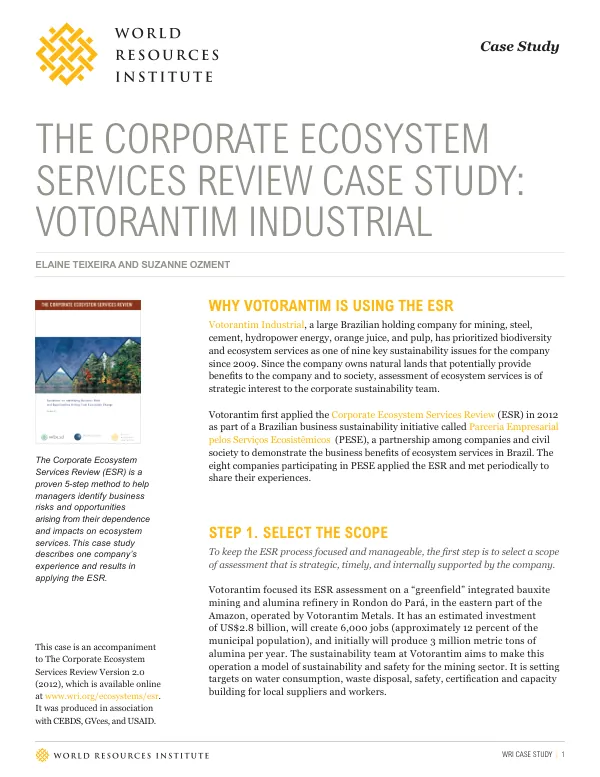
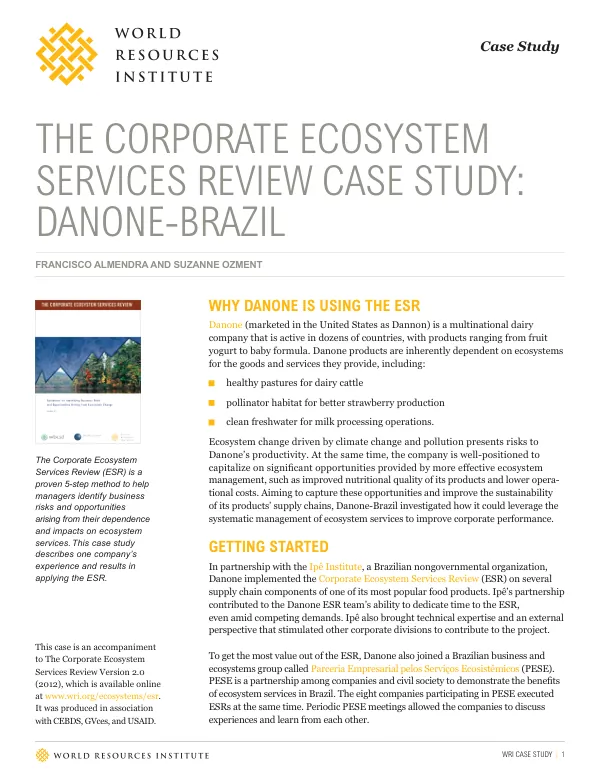
The Corporate Ecosystem Services Review Case Study: Danone-Brazil
Danone, a multinational dairy company, has implemented the Corporate Ecosystem Services Review (ESR) to identify business risks and opportunities arising from its dependence and impacts on ecosystem services.
2013 · 6 pages
Sign in to readA free account is required to download.
Abstract
The company's products, including fruit yogurt and baby formula, are inherently dependent on ecosystems for goods and services such as healthy pastures for dairy cattle, pollinator habitat for better strawberry production, and clean freshwater for milk processing operations. Danone partnered with the Ipê Institute, a Brazilian nongovernmental organization, to implement the ESR on several supply chain components of its most popular food product, Danoninho. The partnership contributed to the Danone ESR team's ability to dedicate time to the ESR, even amid competing demands. Ipê also brought technical expertise and an external perspective that stimulated other corporate divisions to contribute to the project. To get the most value out of the ESR, Danone joined a Brazilian business and ecosystems group called Parceria Empresarial pelos Serviços Ecosistêmicos (PESE). PESE is a partnership among companies and civil society to demonstrate the benefits of ecosystem services in Brazil. The eight companies participating in PESE executed ESRs at the same time, allowing them to discuss experiences and learn from each other. The ESR is a 5-step method to help managers identify business risks and opportunities arising from their dependence and impacts on ecosystem services. Danone focused its ESR on key inputs to strawberry-flavored Danoninho, a popular dairy snack for children in Brazil. The company defined four assessment areas based on vital inputs to the Danoninho product line and applied separate ESRs to each area. Danone prioritized the following ecosystem services for each assessment area: at the production plant, supply of freshwater, water purification and waste treatment, and ecotourism and recreational values; for strawberries, supply of freshwater and regulation of water timing and flows, water purification and waste treatment, maintenance of soil quality, pest mitigation, pollination, and regional and local climate regulation; and for milk, livestock (dairy cows), supply of freshwater, water purification and waste treatment, and maintenance of soil quality. Danone and Ipê consulted several experts for each priority ecosystem service under each assessment area to determine the services' conditions and trends, and to fill any information gaps. The analysis revealed key findings, including the importance of maintaining soil quality for strawberry production and the need to address water pollution and waste treatment for milk processing. The ESR implementation at Danone-Brazil has provided valuable insights into the company's dependence and impacts on ecosystem services. The results have informed a corporate-wide biodiversity strategy planning process and have helped to identify opportunities to enhance biodiversity throughout the Danoninho production process. The ESR has also facilitated collaboration among different corporate divisions and has contributed to the development of a more sustainable supply chain for Danone's products.
Related documents