USAID DEC
The economic cost of upland and gully erosion on subsistence agriculture for a watershed in the Ethiopian highlands
Sign inBAHIR DAR UNIVERSITY
The economic cost of upland and gully erosion on subsistence agriculture for a watershed in the Ethiopian highlands
The economic cost of upland and gully erosion on subsistence agriculture for a watershed in the Ethiopian highlands is a significant concern.
2015 · 14 pages
Sign in to readA free account is required to download.
Abstract
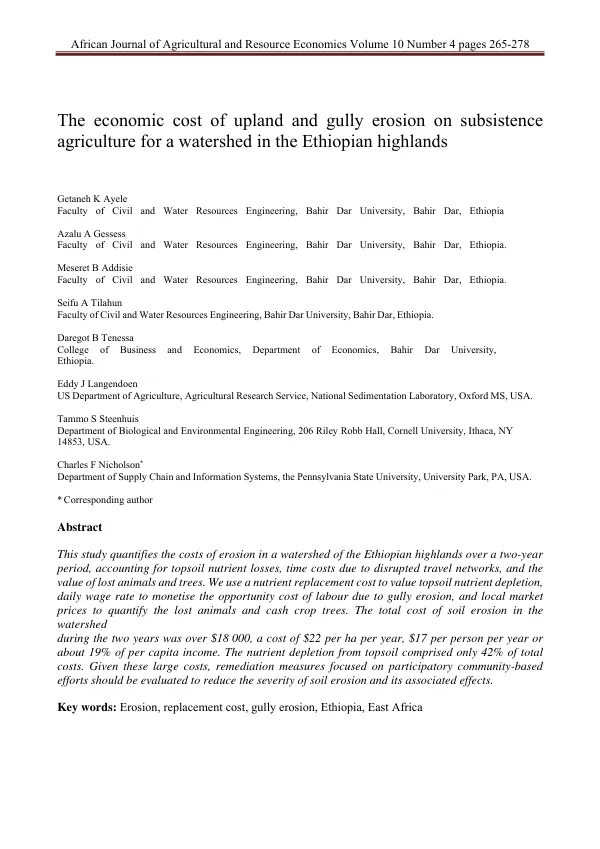
Soil erosion by water is a major problem worldwide, with economic, social, and environmental implications arising from both on-site and off-site effects. In the Ethiopian highlands, soil erosion threatens the sustainability of agriculture due to the importance of subsistence agriculture, with more than 85% of the population living in rural areas and relying on land resources for their livelihood. The study area, Ene-Chilala, is located in the big Birr River watershed in Amhara National Regional State, characterized by rugged topography and steep slopes. Land in the watershed is prone to severe soil erosion due to intensive cultivation, and the steep topography has poor vegetative cover where agriculture is the dominant activity. The study watershed has a total area of 414 ha, with two nested sub-watersheds of 76 and 146 ha, respectively. The study used a replacement-cost approach to estimate the financial on-site cost of soil erosion, which calculates the costs that would have to be incurred in order to replace eroded soil. This approach is suitable for the study watershed due to the availability of nutrient loss data and the rugged, degraded land conditions. The research site is characterized by steep slopes, and farmers apply commercial fertilizers to maintain agricultural production. The subsistence agriculture systems in the watershed are entirely rain-fed, and crop yields depend on rainfall and pre- and post-harvest management. The study estimated the replacement cost of nutrients lost due to both upland and gully erosion in the watershed. The total cost of soil erosion in the watershed over a two-year period was estimated to be over $18,000, with a cost of $22 per ha per year, $17 per person per year, or about 19% of per capita income. The nutrient depletion from topsoil comprised only 42% of total costs. The study also estimated the household-level value of time costs due to the disruption of existing footpaths due to gully erosion and quantified other environmental costs of gully formation, such as the loss of animals and perennial trees. The study's findings highlight the significant economic costs of upland and gully erosion on subsistence agriculture in the Ethiopian highlands. The results suggest that remediation measures focused on participatory community-based efforts should be evaluated to reduce the severity of soil erosion and its associated effects. The study's methods can be applied in other locations to estimate the economic costs of soil erosion and provide a basis for prioritizing land management practices.