USAID DEC
The effect of the temporal resolution of the wind forcing on a central Mediterranean Sea model
Sign inUSAID DEC
The effect of the temporal resolution of the wind forcing on a central Mediterranean Sea model
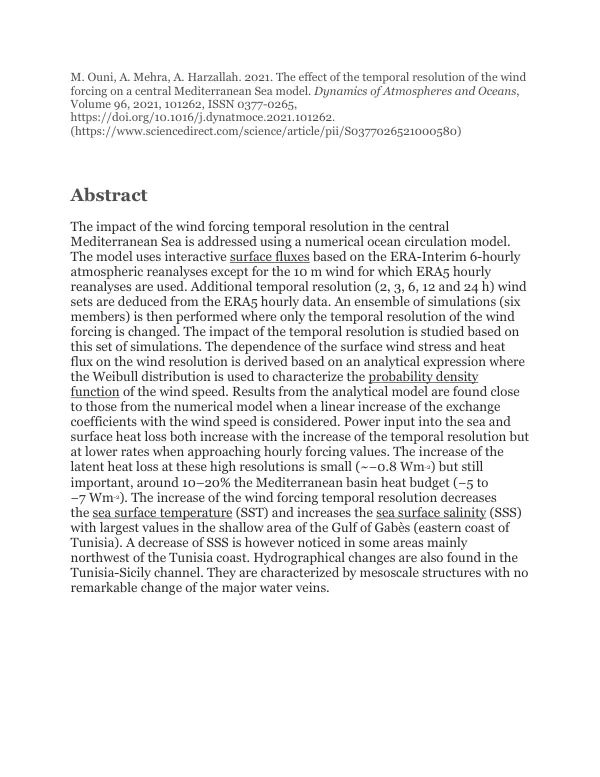
The central Mediterranean Sea model uses interactive surface fluxes based on ERA-Interim 6-hourly atmospheric reanalyses, except for the 10 m wind, which is derived from ERA5 hourly reanalyses.
2021 · 1 pages
Sign in to readA free account is required to download.
Abstract
Additional temporal resolutions of 2, 3, 6, 12, and 24 hours are obtained from ERA5 hourly data. An ensemble of six simulations is performed, varying only the temporal resolution of the wind forcing. The dependence of surface wind stress and heat flux on wind resolution is analyzed using an analytical expression based on the Weibull distribution to characterize the probability density function of wind speed. Results from the analytical model are found to be consistent with those from the numerical model when a linear increase of exchange coefficients with wind speed is considered. Power input into the sea and surface heat loss both increase with higher temporal resolutions, but at lower rates as the resolution approaches hourly values. The increase in latent heat loss at high resolutions is relatively small, approximately -0.8 W/m^2, but still significant, accounting for 10-20% of the Mediterranean basin heat budget (-5 to -7 W/m^2). The increase in wind forcing temporal resolution leads to a decrease in sea surface temperature (SST) and an increase in sea surface salinity (SSS), with the largest changes observed in the shallow area of the Gulf of Gabès, located on the eastern coast of Tunisia. Hydrographical changes are also noted in the Tunisia-Sicily channel, characterized by mesoscale structures with no significant alteration of major water veins. The analysis reveals a decrease in SSS in some areas, primarily northwest of the Tunisia coast. These findings highlight the importance of wind forcing temporal resolution in accurately modeling ocean circulation and heat flux in the central Mediterranean Sea. The results of this study demonstrate the impact of wind forcing temporal resolution on ocean circulation and heat flux in the central Mediterranean Sea. The analysis provides insights into the dependence of surface wind stress and heat flux on wind resolution, as well as the effects on sea surface temperature and salinity. These findings have implications for the development of accurate numerical models of ocean circulation and the prediction of climate-related phenomena in the Mediterranean region.