USAID DEC
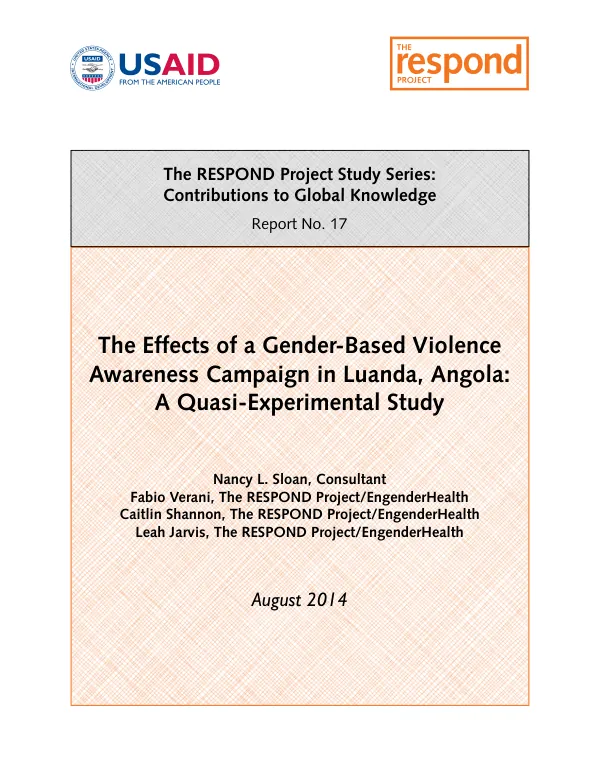
The Effects of a Gender-Based Violence Awareness Campaign in Luanda, Angola: A Quasi-Experimental Study
Sign inENGENDERHEALTH
The Effects of a Gender-Based Violence Awareness Campaign in Luanda, Angola: A Quasi-Experimental Study
The RESPOND Project Study Series: Contributions to Global Knowledge Report No.
2014 · 98 pages
Sign in to readA free account is required to download.
Abstract
17, The Effects of a Gender-Based Violence Awareness Campaign in Luanda, Angola: A Quasi-Experimental Study, was conducted in August 2014. The study aimed to evaluate the impact of a gender-based violence awareness campaign in Luanda, Angola. The background of the study highlights the status of women in Angola, where women face significant challenges, including high rates of gender-based violence. According to Table 1, 64% of women aged 15-49 who were ever married or in union reported experiencing physical violence from a husband or partner, while 55% reported experiencing emotional violence. The study also notes that gender-based violence is a significant public health concern in Angola. The intervention, a gender-based violence awareness campaign, was implemented in Luanda, Angola, and consisted of various stages, messages, and aims, as depicted in Figure 1. The campaign aimed to increase awareness and knowledge about gender-based violence, promote gender equity, and encourage men to take a more active role in preventing violence against women. The evaluation methodology used a quasi-experimental design, with a control group and an intervention group. The study collected data from 1,200 participants, who were surveyed at baseline and endline. The survey questions were designed to assess participants' knowledge, attitudes, and behaviors related to gender-based violence. The results of the study indicate that the campaign had a significant impact on participants' knowledge, attitudes, and behaviors related to gender-based violence. According to Table 3, 71% of respondents reported exposure to GBV-related messages at endline, compared to 45% at baseline. The study also found that exposure to the campaign messages was associated with increased knowledge and awareness about gender-based violence, as well as changes in attitudes and behaviors related to gender roles and violence. The study found that participants who were exposed to the campaign messages were more likely to agree that men and women should have equal access to social, economic, and political opportunities, as shown in Table 2. The study also found that participants who were exposed to the campaign messages were more likely to report that domestic chores were shared equally or done together, and that they were satisfied with the household division of labor. The study also found that the campaign had a significant impact on participants' willingness to respond to incidents of violence against women. According to Table 13, 83% of respondents reported that they would be willing to respond when observing a violent episode between a woman and a strange man, compared to 73% at baseline. The study concludes that the gender-based violence awareness campaign in Luanda, Angola, was effective in increasing knowledge, awareness, and attitudes related to gender-based violence, as well as promoting gender equity and encouraging men to take a more active role in preventing violence against women. The study recommends that the campaign be scaled up and replicated in other settings to address the significant public health concern of gender-based violence in Angola. The study also highlights the importance of involving men in efforts to prevent violence against women and promoting gender equity. The study notes that men's involvement in preventing violence against women is critical to achieving gender equality and promoting a culture of respect and equality. The study's findings have implications for policy and programming efforts to address gender-based violence in Angola and other settings. The study's results suggest that awareness campaigns and education programs can be effective in promoting knowledge, attitudes, and behaviors related to gender-based violence, and that involving men in these efforts is critical to achieving gender equality and promoting a culture of respect and equality.
Related documents