USAID DEC
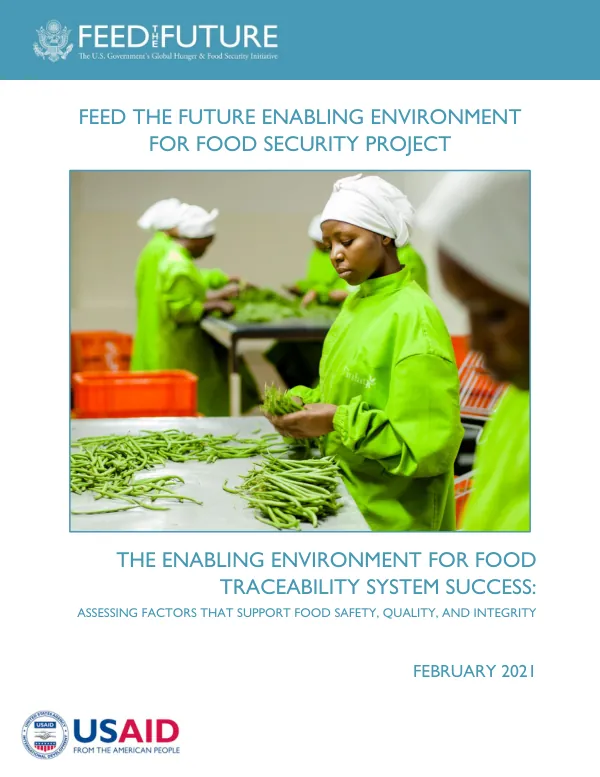
The Enabling Environment for Food Traceability System Success: Assessing Factors That Support Food Safety, Quality, and Integrity
Sign inFINTRAC
The Enabling Environment for Food Traceability System Success: Assessing Factors That Support Food Safety, Quality, and Integrity
The Enabling Environment for Food Traceability System Success project was initiated in 2021 to assess factors that support food safety, quality, and integrity.
2021 · 62 pages
Sign in to readA free account is required to download.
Abstract
The project aimed to identify key drivers for food traceability system (FTS) success and provide guidance for investment in FTS. Food traceability systems involve tracking the movement of food products through the supply chain, from production to consumption. The widespread adoption of FTS holds the potential to mitigate food safety risks, improve market access, and increase productivity gains. However, the uptake of FTS remains relatively low in developing countries, placing them at a competitive disadvantage in market channels that increasingly require traceability. The project identified several key drivers for FTS success, including the role of technology, consumer demand, national laws and regulations, voluntary standards, and international organizations. The use of technology, such as distributed ledger technology and radio frequency identification, can enhance supply chain transparency and improve the efficiency of FTS. Consumer demand for safe and high-quality food products also drives the adoption of FTS. National laws and regulations play a crucial role in promoting the adoption of FTS. The European Union, for example, has implemented strict regulations on food traceability, while the United States has introduced the Food Safety Modernization Act to improve food safety. Voluntary standards, such as the Global Food Safety Initiative, also provide a framework for FTS adoption. International organizations, such as the Food and Agriculture Organization of the United Nations and the World Trade Organization, have developed guidelines and standards for FTS. These organizations have also provided technical assistance and capacity-building programs to support the adoption of FTS in developing countries. The project presented several case studies of FTS adoption in different countries, including Brazil, Colombia, Bangladesh, Ghana, and Fiji. These case studies highlighted the benefits of FTS adoption, including improved food safety, increased market access, and enhanced productivity gains. The project concluded that the adoption of FTS is critical for developing country food systems, which bear a significant share of the global burden of foodborne illnesses. By supporting the introduction, adoption, and implementation of FTS in developing countries, the project aimed to improve food safety, quality, and integrity, and promote mutually beneficial trade between countries. The project's findings and recommendations are intended to guide investment in FTS and support the development of enabling environments for FTS adoption. The project's results are expected to contribute to the improvement of food safety, quality, and integrity, and promote the competitiveness of developing country food operators in global market channels.