USAID DEC
The evolutionary history of Lygodactylus lizards in the South American open diagonal
Sign inELSEVIER LTD.
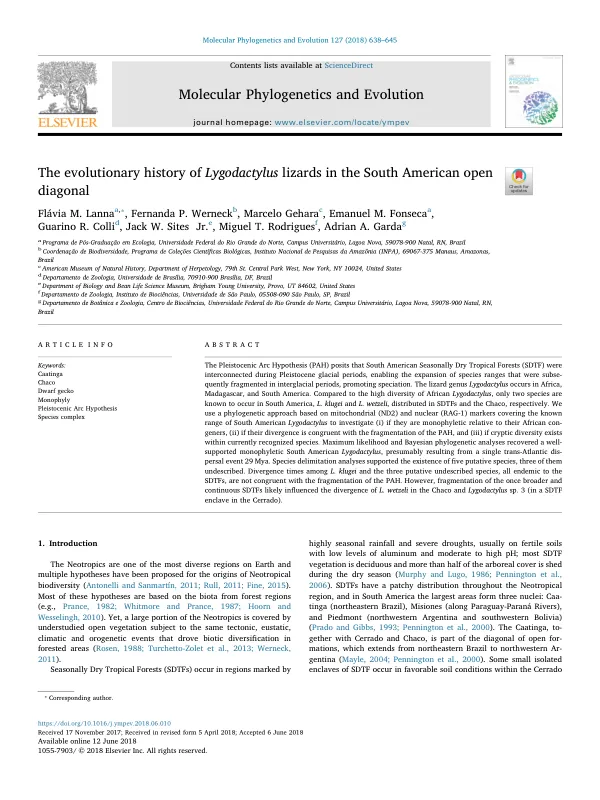
The evolutionary history of Lygodactylus lizards in the South American open diagonal
The lizard genus Lygodactylus comprises 64 species, with 62 occurring in Africa and Madagascar, and two in South America.
2018 · 12 pages
Sign in to readA free account is required to download.
Abstract
Lygodactylus likely colonized South America via trans-Atlantic dispersal from Africa around 25 mya. The two South American species, L. klugei and L. wetzeli, have similar morphologies, are endemic to the diagonal of open formation, and have disjunct distributions. These geckos are very small, elusive, arboreal, and diurnal. The Pleistocenic Arc Hypothesis (PAH) posits that the disjunct distribution of present-day Seasonally Dry Tropical Forests (SDTFs) results from repeated cycles of expansion and retraction during cold/dry and hot/wet Pleistocene climatic cycles, respectively. This hypothesis suggests that a continuous formation reached its maximum extension during the Last Glacial Maximum (LGM) in the late Pleistocene. However, hindcast environmental distribution models suggested expansion of SDTFs during the Late Pliocene/Early Pleistocene, and their fragmentation prior to the LGM. The evolutionary history of South American Lygodactylus is poorly known, and no molecular analysis has ever been conducted to assess the monophyly of these species in relation to their African congeners, the timing of their divergence, or the role of landscape and climate evolution upon their distributions. A molecular phylogenetic approach was used to assess the monophyly, the existence of cryptic species, and the influence of the Pleistocenic Arc in the diversification of South American Lygodactylus. The study predicts that South American Lygodactylus should be monophyletic, reflecting a single dispersal event from African ca. 25 Mya, and that their diversification in South America was driven by Pleistocene climatic cycles. Taxon sampling involved sequencing 25 individuals of South American Lygodactylus from eight localities, including one in the Chaco, one in a Cerrado SDTF enclave, and six in the Caatinga. Vouchers are deposited in Coleção Herpetológica da Universidade Federal do Rio Grande do Norte (UFRN), Coleção Herpetológica da Universidade de Brasília (CHUNB), and Coleção Herpetológica do Museu de Zoologia da Universidade de São Paulo (MZUSP). To improve species tree calibration and test the monophyly of South American Lygodactylus, sequences of 18 African congeners available in GenBank were used. Phylogenetic analyses recovered a well-supported monophyletic South American Lygodactylus, presumably resulting from a single trans-Atlantic dispersal event 29 Mya. Species delimitation analyses supported the existence of five putative species, three of them undescribed. Divergence times among L. klugei and the three putative undescribed species, all endemic to the SDTFs, are not congruent with the fragmentation of the PAH. However, fragmentation of the once broader and continuous SDTFs likely influenced the divergence of L. wetzeli in the Chaco and Lygodactylus sp. 3 in a SDTF enclave in the Cerrado.
Related documents
Documents in this collection
 2023
2023USAID DEC
The liver transcriptome of suckermouth armoured catfish (Pterygoplichthys anisitsi, Loricariidae): Identification of expansions in defensome gene families
Open record 2017
2017USAID DEC