MANAGEMENT SCIENCES FOR HEALTH
The Health Leadership Project: Strengthening Health Systems in Haiti
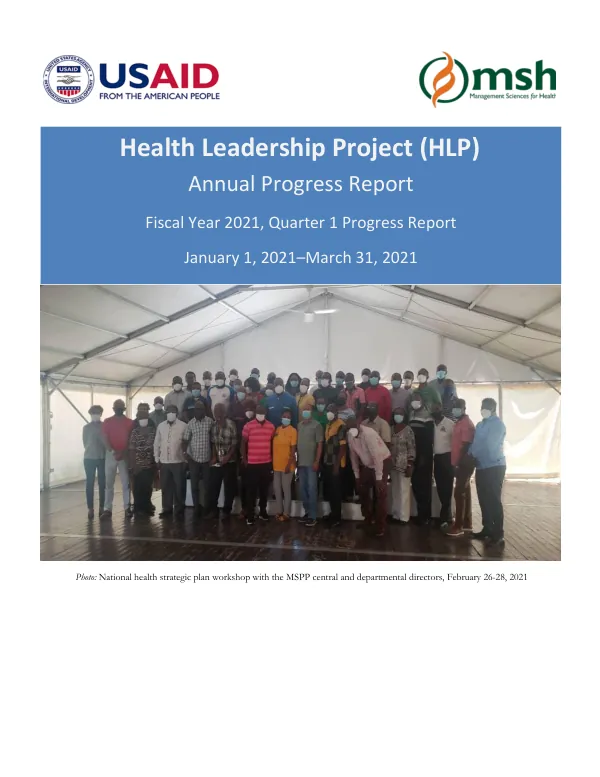
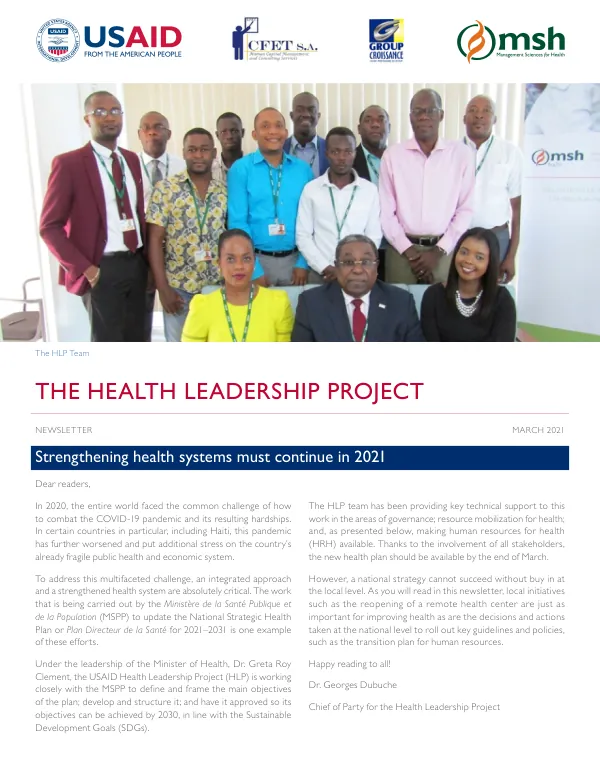
The Health Leadership Project (HLP) is a collaborative effort between the Ministère de la Santé Publique et de la Population (MSPP) and the USAID Health Leadership Project to strengthen Haiti's health system.
2021 · 3 pages
Sign in to readA free account is required to download.
Abstract
The project's primary objective is to update the National Strategic Health Plan for 2021-2031, aligning it with the Sustainable Development Goals (SDGs). Under the leadership of Minister of Health Dr. Greta Roy Clement, the HLP team provides technical support in governance, resource mobilization, and human resources for health (HRH). The HLP team has been working closely with the MSPP to develop and structure the new health plan, which aims to achieve its objectives by 2030. The plan focuses on key areas, including governance, resource mobilization, and HRH. The HLP team has also been providing technical support to the MSPP to design and carry out an assessment of the level of services being provided at a representative sample of health facilities around the country. One example of the HLP's efforts is the reopening of a remote health center in Morne à Brûler, a hard-to-reach community in la Vallée de Jacmel. The health center had been closed for three years due to poor quality services, forcing the population to walk for hours or pay a heavy price for transportation to reach the closest health center. The MSPP, with the support of the HLP, conducted an assessment visit and discovered the closed health center. Dr. Ted Lazarre, Technical Officer for the Direction d'Organisation des Services de Santé (DOSS), organized a meeting with community members to develop a plan to reopen the facility. The HLP helped facilitate discussions with the Directeur Départemental to agree to staff the health center two days a week with health providers from a neighboring facility. The reopening of the health center in Morne à Brûler is a testament to the effectiveness of the HLP's efforts in strengthening Haiti's health system. The community is now able to access health services, including vaccinations and health consultations, in their own community. The HLP's work has also shown that local initiatives, such as the reopening of a remote health center, are crucial for improving health outcomes. Ensuring adequate human resources for health is a significant challenge for Haiti's health system. The country relies heavily on donor funding to pay the salaries of 21% of public-sector health providers. The HLP has been working with the MSPP to develop a transition plan for human resources, which aims to have the Haitian government directly pay the salaries of 4,964 donor-paid health care providers or community outreach workers by 2030. The plan focuses on gradually absorbing health workers previously paid by donors into the government's budget, with a particular focus on staff working on HIV, tuberculosis, and malaria prevention, care, and treatment. The transition plan involves several key components, including a mapping of donor-funded health workers, definitions of selection criteria and process, and estimation of funds required to absorb these staff according to the country's salary scale. The plan aims to ensure the gradual transfer of health staff to the government's budget, moving Haiti closer to its goal of providing quality health services to its population. In the first year of implementing the plan, the government is on track to transfer more than 450 health agents, including doctors, nurses, lab technicians, and community health workers, for an estimated cost of 778,000 USD.