ENCOMPASS, LLC
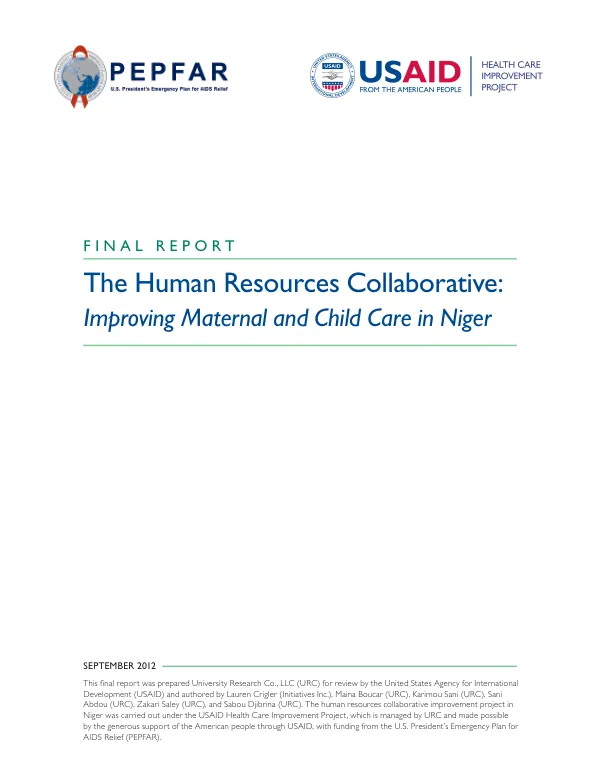
The Human Resources Collaborative: Improving Maternal and Child Care in Niger
The Human Resources Collaborative: Improving Maternal and Child Care in Niger was a project implemented in the Tahoua Region of Niger from 2009 to 2011.
2012 · 62 pages
Sign in to readA free account is required to download.
Abstract
The project aimed to improve maternal and child care by strengthening the human resources of the health system. The collaborative was supported by the United States Agency for International Development (USAID) and its Office of HIV/AIDS in the Bureau for Global Health, with funding from the U.S. President's Emergency Plan for AIDS Relief (PEPFAR). The project was implemented by staff of University Research Co., LLC (URC) and Initiatives Inc. through the USAID Health Care Improvement Project (HCI), which is managed by URC under the terms of Contract Number GHN-I-03-07-00003-00. The collaborative involved multiple stakeholders, including the Ministry of Public Health of Niger, health facilities, and community-based organizations. The project's goal was to improve the performance of health workers and the overall quality of care provided to mothers and children. To achieve this goal, the collaborative implemented a range of interventions, including training programs, coaching, and the development of a human resources performance improvement change package. The package included a set of tools and strategies designed to improve the performance of health workers and the overall quality of care provided. The project's results showed significant improvements in the performance of health workers and the quality of care provided. The percentage of health workers with job descriptions increased from 22% in 2009 to 73% in 2011. The percentage of health workers who received feedback discussions increased from 15% in 2009 to 63% in 2011. The percentage of health workers who were engaged in their work also increased, with 71% of literate workers and 55% of illiterate workers reporting that they were engaged in their work in 2011. The project also showed significant improvements in clinical outcomes, including a 25% increase in deliveries assisted by a qualified health worker and a 15% decrease in the postpartum hemorrhage rate. The project also showed improvements in the use of essential newborn care (ENC) norms and the existence of adequate job descriptions. The project's findings suggest that the collaborative approach was effective in improving the performance of health workers and the quality of care provided. The project's results also suggest that the human resources performance improvement change package was an effective tool for improving the performance of health workers and the overall quality of care provided. The project's conclusions and recommendations highlight the importance of investing in the human resources of the health system to improve maternal and child care. The project's findings suggest that the collaborative approach and the human resources performance improvement change package can be effective tools for improving the performance of health workers and the quality of care provided. The project's recommendations include scaling up the collaborative approach and the human resources performance improvement change package to other regions of Niger and other countries in the region.