USAID DEC
The Impact of COVID-19 and Associated Shocks on Agri-Food SMEs along the Poultry and Fish Value Chains in Abuja (FCT)
Sign inINTERNATIONAL FOOD AND POLICY RESEARCH INSTITUTE
The Impact of COVID-19 and Associated Shocks on Agri-Food SMEs along the Poultry and Fish Value Chains in Abuja (FCT)
The COVID-19 pandemic and associated policies had a significant impact on agri-food small and medium-sized enterprises (SMEs) along the poultry and fish value chains in Abuja, Nigeria.
2021 · 9 pages
Sign in to readA free account is required to download.
Abstract
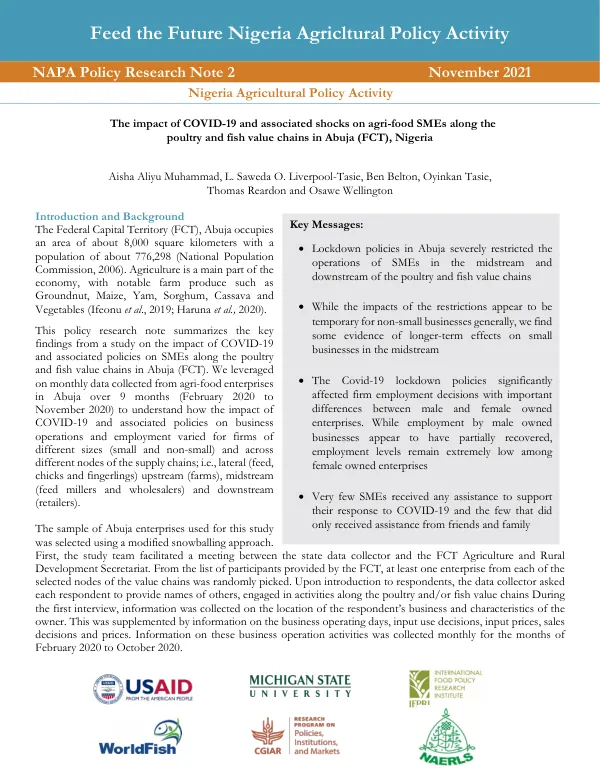
The Federal Capital Territory (FCT) witnessed the first COVID-19 cases on March 3, 2020, and a federally mandated lockdown was imposed on March 30, 2020, which lasted for five weeks. The lockdown severely restricted business activities in the midstream and downstream of SMEs, with a significant reduction in operating days during the lockdown months of April and May 2020. The lockdown policies affected SMEs differently depending on their size and location. Non-small businesses in the lateral supply chain, such as feed mills and hatcheries, tended not to operate for some months but resumed fully in May and onwards. In contrast, smaller SMEs in the lateral supply chain, such as feed mills and hatcheries, tended not to have operated for some months but resumed fully in May and onwards. The disruption of business operations was consistent for both urban and peri-urban areas and among both small and non-small enterprises. The impact of the lockdown policies on SMEs was also evident in the employment decisions. The COVID-19 lockdown policies significantly affected firm employment decisions, with important differences between male and female-owned enterprises. While employment by male-owned businesses appeared to have partially recovered, employment levels remained extremely low among female-owned enterprises. The study also found that very few SMEs received any assistance to support their response to COVID-19, and the few that did only received assistance from friends and family. The lack of support for SMEs during the pandemic highlights the need for targeted interventions to support the recovery of the agri-food sector in Abuja. The poultry population in FCT witnessed a huge reduction due to the pandemic, with egg-gluts recorded as producers could not connect with consumers during lockdown periods. Inputs such as day-old-chicks, feeds, medications, and vaccines were also highly expensive. The fish farming sector in FCT also experienced significant challenges, with a huge reduction in the population of fish farmers and a significant increase in the cost of inputs. The study used monthly data collected from agri-food enterprises in Abuja over 9 months (February 2020 to November 2020) to understand how the impact of COVID-19 and associated policies on business operations and employment varied for firms of different sizes and across different nodes of the supply chains. The sample of Abuja enterprises used for this study was selected using a modified snowballing approach, with at least one enterprise from each of the selected nodes of the value chains randomly picked. The study's findings have important implications for policymakers and stakeholders seeking to support the recovery of the agri-food sector in Abuja. The study highlights the need for targeted interventions to support SMEs, particularly female-owned enterprises, and the need for increased support for the poultry and fish farming sectors. The study also emphasizes the importance of understanding the impact of COVID-19 and associated policies on business operations and employment in the agri-food sector.
Related documents
Documents in this collection
 2021
2021USAID DEC
The impact of COVID-19 and Associated Shocks on Agri Food SMEs along the Poultry and Fish Value Chains in Oyo state
Open record 2021
2021USAID DEC