USAID DEC
The Linkages Across the Continuum of HIV Services for Key Populations Affected by HIV (LINKAGES) Project in Sri Lanka
Sign inUSAID
The Linkages Across the Continuum of HIV Services for Key Populations Affected by HIV (LINKAGES) Project in Sri Lanka
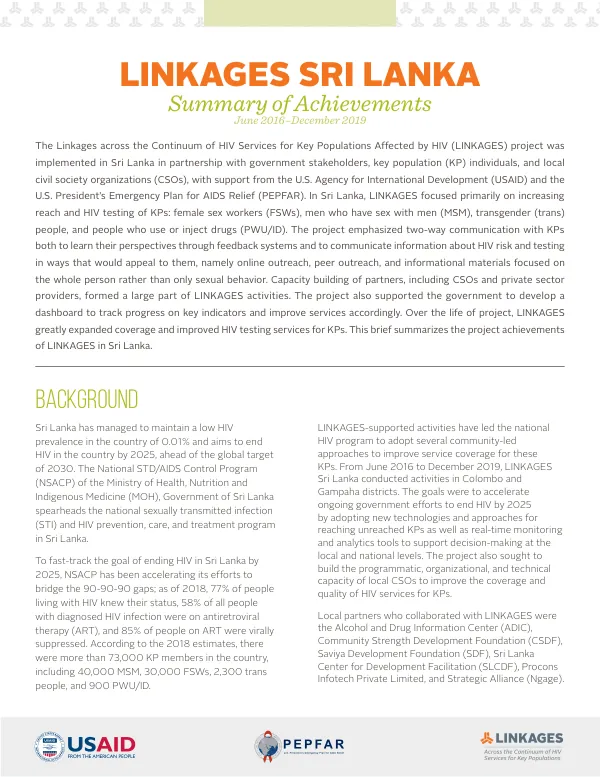
The LINKAGES project in Sri Lanka aimed to increase reach and HIV testing of key populations (KPs) affected by HIV, including female sex workers (FSWs), men who have sex with men (MSM), transgender people, and people who use or inject drugs (PWU/ID).
2019 · 8 pages
Sign in to readA free account is required to download.
Abstract
Implemented in partnership with government stakeholders, KP individuals, and local civil society organizations (CSOs), the project received support from the U.S. Agency for International Development (USAID) and the U.S. President's Emergency Plan for AIDS Relief (PEPFAR). The project focused on improving the coverage and uptake of HIV prevention and testing services for KPs, as well as enhancing the quality of community- and clinic-based HIV services. A package of approaches was implemented, including engaging private providers, using the enhanced peer outreach approach (EPOA), and online outreach strategies. The project also supported the development of a National Key Population Program Monitoring Dashboard and key indicators to inform programmatic decision-making. Technical highlights of the project include the expansion of KP-friendly HIV testing provision by training 146 private providers on HIV testing services, launching the Know4sure online platform, which saw 15,253 users, and setting up community- and clinic-based client feedback systems for KPs about services they received. The project also supported KP individuals through socioeconomic vulnerability-reduction activities intended to drive demand for HIV services among peers. The Know4sure online platform was designed to provide a risk self-assessment and appointment booking service for HIV and STI testing. Several online approaches were piloted on the platform, including network outreach, social media influencers, and social media advertising. The results showed a multifold increase in reach through advertising, allowing the program to pass on information and encourage clients to practice safe sex and get tested regularly for HIV and STIs. Engagement of private providers was also a key strategy for improving early diagnosis and linkage to treatment. From April 2018 to September 2019, 146 private practitioners attended trainings held with the College of General Practitioners (CGP) of Sri Lanka, Independent Medical Practitioners Association (IMPA), and support staff from local STD clinics in Colombo and Gampaha districts. The project achieved its program goals of improving reach and HIV testing coverage among KPs. The National Key Population Program Monitoring Dashboard and key indicators were developed to inform programmatic decision-making, address supply-chain issues, and link KP members to HIV testing. The project also built the capacity of CSO partners through the establishment of three learning sites to support improvements in HIV testing services and KP programming. The project's success was measured through various indicators, including the number of KP individuals reached and tested, the number of private providers trained, and the number of clients who completed a risk assessment and booked an appointment for HIV testing. The results showed a significant increase in reach and testing among KPs, as well as improvements in the quality of community- and clinic-based HIV services. The project's achievements have contributed to the national goal of ending HIV in Sri Lanka by 2025. The National STD/AIDS Control Program (NSACP) has adopted several community-led approaches to improve service coverage for KPs, and the project has supported the development of a National Key Population Program Monitoring Dashboard and key indicators to inform programmatic decision-making. The project's success has also demonstrated the effectiveness of engaging private providers and using online outreach strategies to improve reach and testing among KPs.
Related documents