ICF
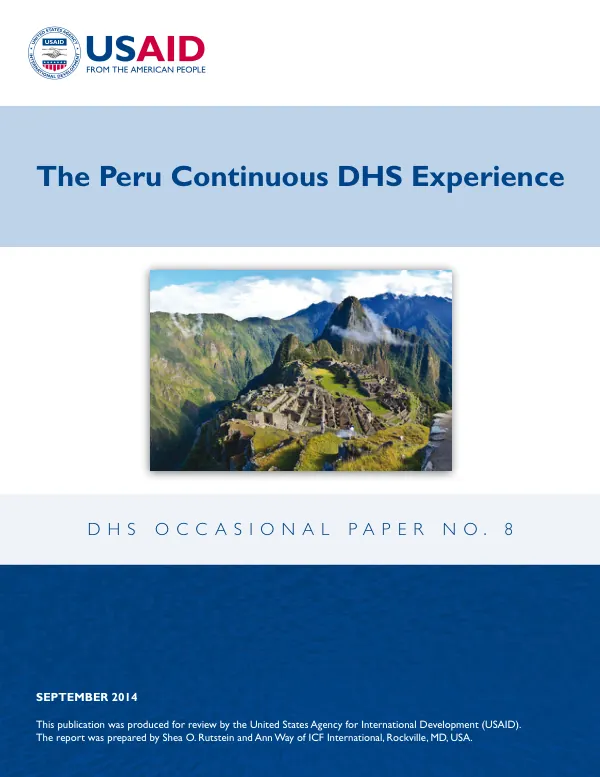
The Peru Continuous DHS Experience
The Peru Continuous DHS Experience was initiated in 2004 as part of The Demographic and Health Survey (DHS) Program.
2014 · 52 pages
Sign in to readA free account is required to download.
Abstract
This continuous survey operation replaced the standard DHS conducted at a five-year interval with a permanently maintained DHS office and field staff collecting and reporting data annually. The Peru Continuous DHS was designed to strengthen host country capacity to conduct the DHS, create an informed stakeholder base, and implement the survey within the same cost parameters as a standard DHS. The survey's initial design included a sample of approximately 10,000 households, which was selected using a stratified sampling method. The survey contents included a range of topics, including demographic characteristics, health and nutrition, and women's empowerment. The survey was implemented in multiple rounds, with each round collecting data on a subset of the sample households. The data processing and dissemination were carried out by the National Institute of Statistics and Informatics of Peru, with technical assistance from ICF International. One of the key goals of the Peru Continuous DHS was to provide subnational data, which was achieved through the implementation of a rotating panel design. This design allowed for the collection of data from a subset of households in each round, while also maintaining a representative sample of households across the country. The survey also included a range of indicators to track trends and short-term changes in population, health, and nutrition outcomes. The Peru Continuous DHS experience has been successful in providing high-quality data to inform policy and program decisions. The survey has been implemented for over a decade, with multiple rounds of data collection. The data have been used to track trends and short-term changes in population, health, and nutrition outcomes, and to inform policy and program decisions at the national and subnational levels. The Peru Continuous DHS has also provided valuable lessons for other countries considering implementing a continuous survey operation. The survey's design and implementation have been adapted to meet the needs of the Peruvian government and stakeholders, and have provided a model for other countries to follow. The survey has also highlighted the importance of strengthening host country capacity to conduct the DHS, creating an informed stakeholder base, and implementing the survey within the same cost parameters as a standard DHS. The Peru Continuous DHS has been supported by the United States Agency for International Development (USAID) through The DHS Program. The views expressed in this report are those of the authors and do not necessarily reflect the views of USAID or the United States Government. The DHS Program assists countries worldwide in the collection and use of data to monitor and evaluate population, health, and nutrition programs. The survey's data have been used to track trends and short-term changes in population, health, and nutrition outcomes, and to inform policy and program decisions at the national and subnational levels. The data have also been used to evaluate the impact of programs and policies on population, health, and nutrition outcomes. The survey's findings have been published in a range of reports and publications, including the Peru Continuous DHS Experience report. The Peru Continuous DHS has been implemented in multiple rounds, with each round collecting data on a subset of the sample households. The survey has been implemented in a range of settings, including urban and rural areas, and has collected data on a range of topics, including demographic characteristics, health and nutrition, and women's empowerment. The survey's data have been used to inform policy and program decisions at the national and subnational levels, and have provided valuable insights into population, health, and nutrition outcomes in Peru.
Related documents