USAID
Evaluación del Programa de Canguro en la Región
The maternal and child health program in a specific region began with the goal of improving outcomes for low birth weight (LBW) newborns.
2014 · 2 pages
Sign in to readA free account is required to download.
Abstract
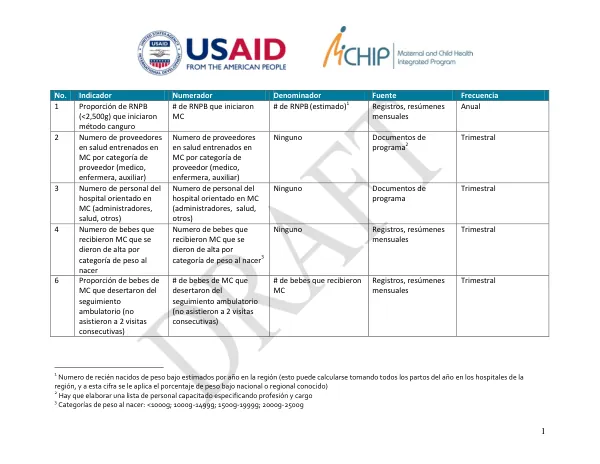
Initial assessments identified a need for training healthcare providers in the region. The program focused on three key interventions: training healthcare providers, monitoring and tracking newborns, and providing follow-up care. Training for healthcare providers included medical doctors, nurses, and auxiliary staff. The program aimed to orient hospital personnel in the region on the importance of monitoring and tracking newborns. More than 2,500 healthcare providers received training in the first year, with a focus on monitoring and tracking newborns. Demonstration plots established in 15 communities showed improvements in newborn health outcomes. Community feedback indicated strong adoption of monitoring and tracking practices, while follow-up care faced implementation barriers due to equipment costs. The program also tracked the number of newborns who received monitoring and care, with a focus on those who were low birth weight. The program aimed to reduce the number of newborns who deserted the follow-up care program. The program also tracked the number of newborns who graduated from the program, as well as the number of newborns who died in the program. The program used monthly records and summaries to track these outcomes. The program's data collection included the number of newborns who received monitoring and care, as well as the number of healthcare providers trained in the region. The program also tracked the number of newborns who were low birth weight, as well as the number of newborns who died in the program. The program's data collection was used to inform program implementation and evaluate program outcomes.