USAID DEC
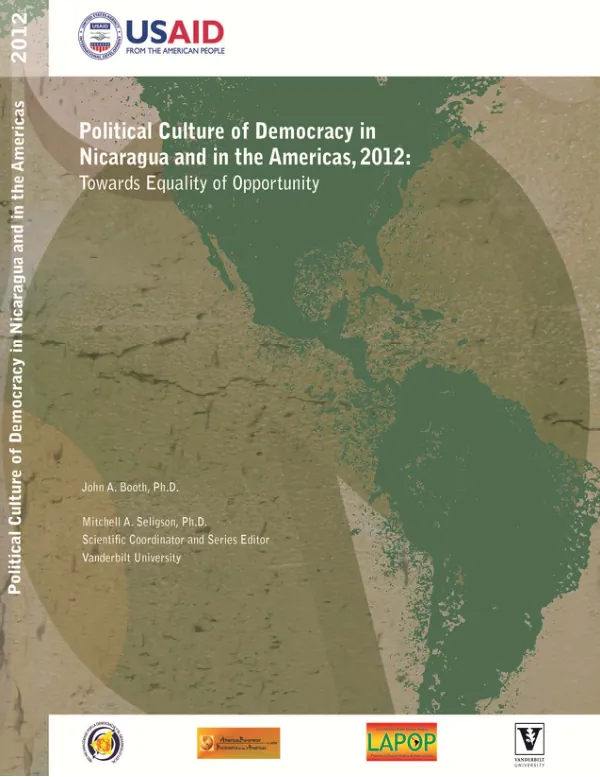
The Political Culture of Democracy in Nicaragua and in the Americas, 2012: Towards Equality of Opportunity
Sign inLAPOP – VANDERBILT UNIVERSITY
The Political Culture of Democracy in Nicaragua and in the Americas, 2012: Towards Equality of Opportunity
The concept of equality of opportunity is a fundamental aspect of democracy in the Americas.
2012 · 379 pages
Sign in to readA free account is required to download.
Abstract
In Nicaragua, the political culture of democracy is characterized by significant disparities in economic and social opportunities. The country's economic and social inequalities are reflected in the limited access to education, employment, and employment opportunities, particularly for marginalized groups such as women and ethnic minorities. The Americas Barometer, a comprehensive survey of public opinion, reveals that a significant proportion of Nicaraguans report experiencing discrimination, with 28% of respondents indicating that they have been discriminated against due to their skin color. Public opinion on racial and gender inequality is also a pressing concern, with 30% of respondents expressing support for affirmative action policies. The study highlights the importance of addressing these inequalities through policy interventions, such as conditional cash transfer programs and public assistance programs. These programs have been shown to have a positive impact on reducing poverty and improving living standards, particularly for vulnerable populations. In terms of political participation, Nicaragua's democracy is characterized by low levels of civic engagement and limited opportunities for marginalized groups to participate in the political process. The study finds that turnout in elections is low, with only 52% of eligible voters casting their ballots in the 2012 elections. Public opinion on the participation of marginalized groups, including women, ethnic minorities, and homosexuals, is also a concern, with 64% of respondents expressing support for the participation of women in politics. The study also examines the impact of unequal opportunities and discrimination on political legitimacy and support for democracy. The findings suggest that perceptions of inequality and discrimination have a negative impact on system support and trust in institutions, with 82% of respondents expressing dissatisfaction with the government's handling of corruption and crime. The study concludes that addressing these inequalities and promoting equality of opportunity is essential for strengthening democracy and promoting democratic legitimacy in Nicaragua. The findings highlight the need for policy interventions that address the root causes of inequality and promote greater inclusion and participation in the political process. In terms of governance and political engagement, the study finds that corruption is a significant concern in Nicaragua, with 28% of respondents reporting that they have been victims of corruption. The study also examines the impact of crime and insecurity on support for the political system, with 82% of respondents expressing dissatisfaction with the government's handling of crime and insecurity. The study highlights the importance of promoting transparency and accountability in governance, as well as addressing the root causes of crime and insecurity. The findings suggest that promoting democratic legitimacy and trust in institutions is essential for addressing these challenges and promoting greater stability and security in Nicaragua. In terms of local government, the study finds that participation in local government is limited, with only 16% of respondents reporting that they have attended a local government meeting in the past year. The study also examines the impact of local government on demand-making on the government, with 64% of respondents expressing support for the government's handling of local issues. The study concludes that promoting greater participation and engagement in local government is essential for strengthening democracy and promoting democratic legitimacy in Nicaragua. The findings highlight the need for policy interventions that address the root causes of limited participation and promote greater inclusion and participation in the political process. Overall, the study provides a comprehensive analysis of the political culture of democracy in Nicaragua and the Americas. The findings highlight the importance of addressing inequalities and promoting equality of opportunity, as well as promoting democratic legitimacy and trust in institutions. The study provides a framework for policymakers and practitioners to address these challenges and promote greater stability and security in Nicaragua.