BANK FOR WEST AFRICAN DEVELOPMENT
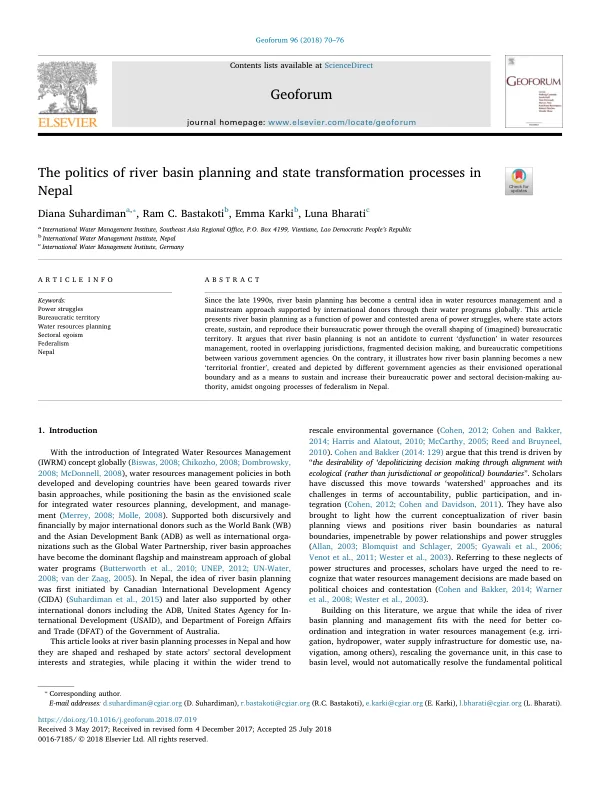
The politics of river basin planning and state transformation processes in Nepal
River basin planning has become a central idea in water resources management, supported by international donors through their water programs globally.
2018 · 7 pages
Sign in to readA free account is required to download.
Abstract
This concept is rooted in the Integrated Water Resources Management (IWRM) approach, which positions the river basin as the envisioned scale for integrated water resources planning, development, and management. The idea of river basin planning was first initiated in Nepal by the Canadian International Development Agency (CIDA) and later supported by other international donors, including the Asian Development Bank (ADB), United States Agency for International Development (USAID), and Department of Foreign Affairs and Trade (DFAT) of the Government of Australia. River basin planning processes are shaped by power structures and relationships, manifested in bureaucratic competition between sectoral ministries, as well as overlapping operational boundaries between government agencies working across different administrative levels. The rescaling of environmental governance to the basin level is driven by the desirability of "depoliticizing decision making through alignment with ecological (rather than jurisdictional or geopolitical) boundaries." However, scholars have argued that this move towards watershed approaches neglects power structures and processes, and that water resources management decisions are made based on political choices and contestation. The concept of river basin planning fits with the need for better coordination and integration in water resources management, but rescaling the governance unit to the basin level would not automatically resolve the fundamental political questions. As stated by Blomquist and Schlager (2005), "The watershed does not resolve fundamental political questions about where the boundaries should be drawn, how participation should be structured, and how and to whom decision makers within a watershed are accountable." Drawing institutional boundaries is indeed a political act, and the basin becomes the newly envisioned, albeit overlapping, bureaucratic territory. River basin planning approaches have become a central positioning in different government ministries' policies and legal frameworks in Nepal. The government ministries' preference for basin planning approaches is rooted in their interest to preserve and increase their bureaucratic power and sectoral decision-making authority, through the framing of basin scale as the scale where the country's water resources should be governed, vis-à-vis ongoing processes of federalism to transfer decision-making authority to provincial and local government bodies. Scholars have highlighted the political characteristics of scale, and how it can be used to shape and reshape power structure and power relationship. The choice to focus on specific scale (e.g. basin level) resembles not only the interests of those in power, but also the process of inclusion and exclusion. The river basin becomes an arena where government ministries compete for influence, jurisdiction, and responsibility, and the basin becomes the newly envisioned, albeit overlapping, bureaucratic territory. A review of policy documents and legal frameworks, as well as series of in-depth semi-structured interviews conducted with government officials, international donor representatives, and civil society organizations, highlights the central positioning of river basin planning approaches in different government ministries' policies and legal frameworks in Nepal. The interviews gathered information on how the different actors perceive current challenges in water resources management and how they view river basin planning approaches as part of their strategies to cope with these challenges. The coding process was done manually and designed in line with NVIVO 10 tool.
Related documents