CHEMONICS
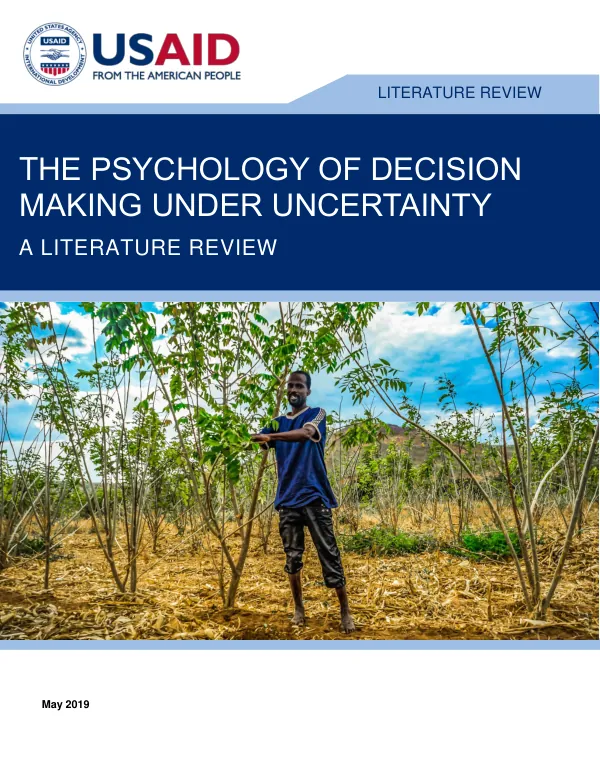
The Psychology of Decision-Making Under Uncertainty: A Literature Review
Climate science poses a problem known as deep uncertainty, where the inherent uncertainty is not likely to be reduced by additional research within the timeframe needed for decision-making.
2019 · 50 pages
Sign in to readA free account is required to download.
Abstract
Decision-making under deep uncertainty is one of the most crucial and unresolved problems in policy making, particularly for climate-related decision-making. This literature review aims to unpack the psychological aspects of individual and group decision-making under deep uncertainty. Individual decision-making is influenced by various factors, including heuristics and biases. The availability heuristic suggests that people make judgments about the likelihood of an event based on how available relevant memories are. For example, if an individual has recently experienced a drought, they may ascribe a higher likelihood to a repeat drought event in the future. The representativeness heuristic refers to the tendency to judge the frequency or likelihood of an event by the extent to which it resembles the "typical" case. The affect heuristic represents a reliance on good or bad feelings experienced in relation to a stimulus, which can influence decisions. The framing effect describes the effect that emphasizing certain dimensions of an issue over others has on decision-making. Experiential versus analytical decision-making is another crucial aspect of individual decision-making. Research in social, cognitive, and clinical psychology shows that the human brain processes information using two systems: one experiential, the other analytical. While these two systems act together to guide judgment and decision-making, experiential thinking is, on the whole, more dominant than analytical thinking. Physiological hardwiring supports the case for using experiential information to support decision-making. However, when using experiential information, it is essential to take note of caveats introduced through concepts such as the "finite pool of worry" notion, the "recency effect," and the "description-experience gap." Group decision-making is also influenced by various factors, including the context in which decisions are made. Group decision-making context can be characterized by factors such as group size, group composition, and decision-making process. Research has shown that group decision-making can be influenced by factors such as groupthink, where group members prioritize consensus over critical evaluation of ideas, and the diffusion of responsibility, where group members shift the responsibility of decision-making to others. Strategies to deal with uncertainty are essential for decision-making under deep uncertainty. Adaptive risk-management strategies, such as scenario planning and decision trees, can help decision-makers navigate uncertainty. Choosing among actions with uncertain outcomes requires a combination of normative models, which provide a rational framework for decision-making, and descriptive models, which reflect the way people actually make decisions. The use of climate change games can also help decision-makers develop strategies for dealing with uncertainty. In conclusion, decision-making under deep uncertainty is a complex problem that requires a deep understanding of the psychological aspects of individual and group decision-making. This literature review has provided an overview of the various factors that influence decision-making under deep uncertainty, including heuristics and biases, experiential versus analytical decision-making, group decision-making context, and strategies to deal with uncertainty. Further research is needed to develop effective strategies for communicating uncertain climate information to decision-makers and to improve the application of climate information in decision-making.