LOCAL CIVIL SOCIETY ORGANIZATIONS
USAID's Tenure and Global Climate Change (TGCC) Program in Zambia
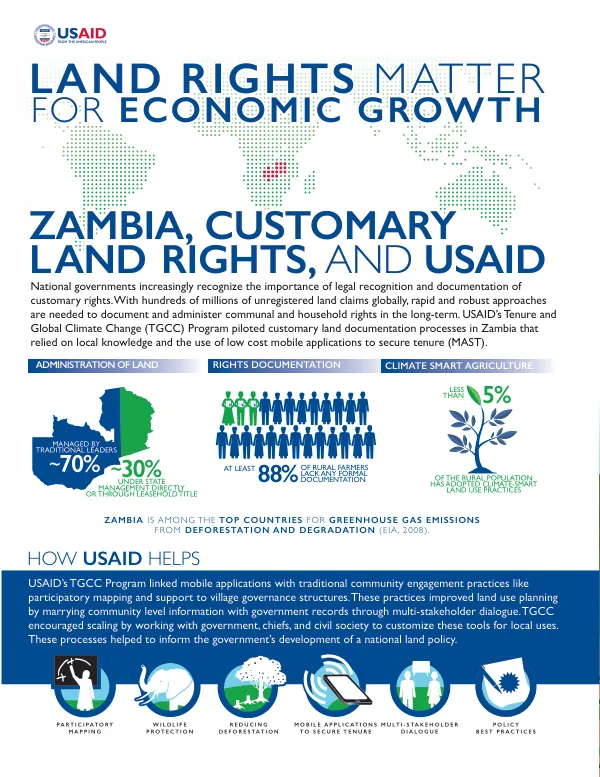
The Tenure and Global Climate Change (TGCC) Program, implemented by USAID, linked mobile applications with traditional community engagement practices to improve land use planning in Zambia.
2018 · 2 pages
Sign in to readA free account is required to download.
Abstract
Participatory mapping and support to village governance structures were key components of this approach, which married community-level information with government records through multi-stakeholder dialogue. This process helped inform the government's development of a national land policy. The program encouraged scaling by working with government, chiefs, and civil society to customize these tools for local uses. Farmers, Ministry of Lands, Local Councils, Traditional Leaders, and Local/International CSOs were among the stakeholders involved in the implementation of the program. The program supported the documentation of more than 16,000 individual parcels of land across over 500 villages and associated administrative structures on both customary and state lands. The program also provided training on tenure-based participatory mapping to USAID partner Frankfurt Zoological Society to support management of North Luangwa National Park and its buffer zones. A randomized control trial was undertaken across over 400 villages to identify linkages between strengthened land rights and adoption of sustainable agricultural practices, including agroforestry. The program documented rights of more than 30,000 people across more than 6,000 parcels. In addition, the program funded 30 district and provincial multi-stakeholder consultations around the national land policy, as well as forums for chiefs to express their views on customary land management. The program also worked with eight chiefs and their advisors who collectively manage more than 700,000 hectares on customary land administration processes and documentation of their chiefdoms. The program's efforts aimed to document and administer communal and household rights in the long-term, addressing the issue of hundreds of millions of unregistered land claims globally. The program's impact was significant, with documented communal as well as household land rights of more than 10,000 parcels across a large landscape of 210,000 hectares that borders a national park and includes a historical refugee resettlement area. The program's work in Zambia highlights the importance of legal recognition and documentation of customary rights for economic growth and sustainable development.