USAID DEC
The role of health facilities in supporting adherence to iron-folic acid supplementation during pregnancy (WP160)
Sign inICF
The role of health facilities in supporting adherence to iron-folic acid supplementation during pregnancy (WP160)
Maternal anemia is a major public health problem in many low- and middle-income countries.
2019 · 2 pages
Sign in to readA free account is required to download.
Abstract
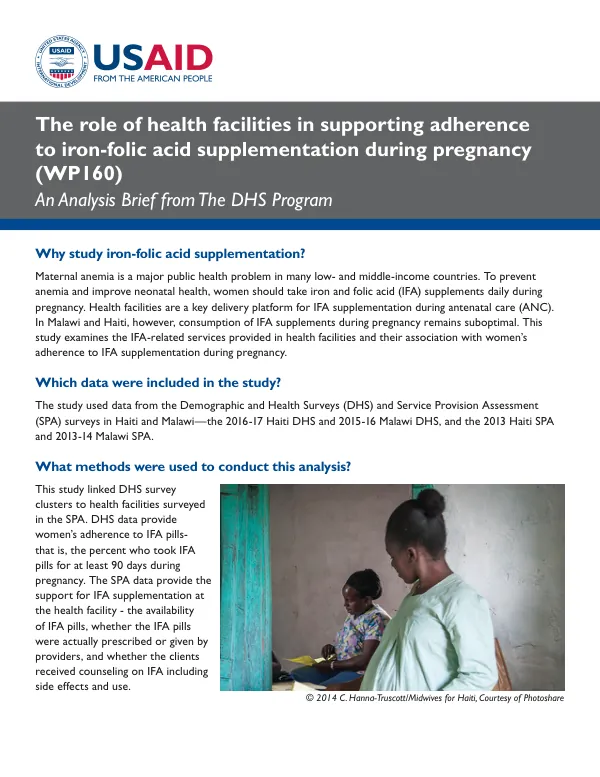
To prevent anemia and improve neonatal health, women should take iron and folic acid (IFA) supplements daily during pregnancy. Health facilities are a key delivery platform for IFA supplementation during antenatal care (ANC). In Malawi and Haiti, however, consumption of IFA supplements during pregnancy remains suboptimal. This study examines the IFA-related services provided in health facilities and their association with women's adherence to IFA supplementation during pregnancy. The study used data from the Demographic and Health Surveys (DHS) and Service Provision Assessment (SPA) surveys in Haiti and Malawi. The DHS data provide women's adherence to IFA pills, while the SPA data provide information on the support for IFA supplementation at the health facility. The study linked DHS survey clusters to health facilities surveyed in the SPA to examine the association between IFA-related services and women's adherence to IFA supplementation. The key results of the study indicate that more than 2/3 of ANC facilities in Haiti and almost all ANC facilities in Malawi had IFA pills available. However, counseling on IFA was less common in both countries, and counseling focused on how to take IFA pills, with very few women receiving counseling on side effects of IFA pills. The household survey data show that only 42% of women in Haiti and 35% of women in Malawi took IFA pills for at least 90 days. Adherence was higher in urban areas than rural areas in both countries. The linked analysis reveals that in rural areas of both countries, women were more likely to comply with taking IFA pills for 90+ days in clusters with a high level of availability of ANC facilities offering IFA supplementation. IFA counseling at health facilities was associated with higher odds of IFA compliance in rural areas of Malawi but not Haiti. Women who made 4+ ANC visits in both countries were more likely to take IFA pills for 90+ days. The study concludes that less than half of pregnant women in Haiti and Malawi took IFA pills for 90 days. Rural women with greater access to health facilities offering ANC with IFA supplements available had a greater likelihood of IFA compliance. Continued efforts are required to address access to IFA supplementation through increasing both the use of ANC services and their quality, particularly in provider counseling. As a complement to existing facility-based programs, community-based IFA supplement distribution may provide an opportunity to improve quality of care and to increase IFA coverage.
Related documents
![Measurement Approaches for Effective Coverage Estimation [MR31]](https://covers.devme.ai/gen/138167.webp)