USAID DEC
The Savings and Loan Associations System in the United States
The Savings and Loan Associations system in the United States constitutes the primary source of home financing in this country.
2010 · 44 pages
Sign in to readA free account is required to download.
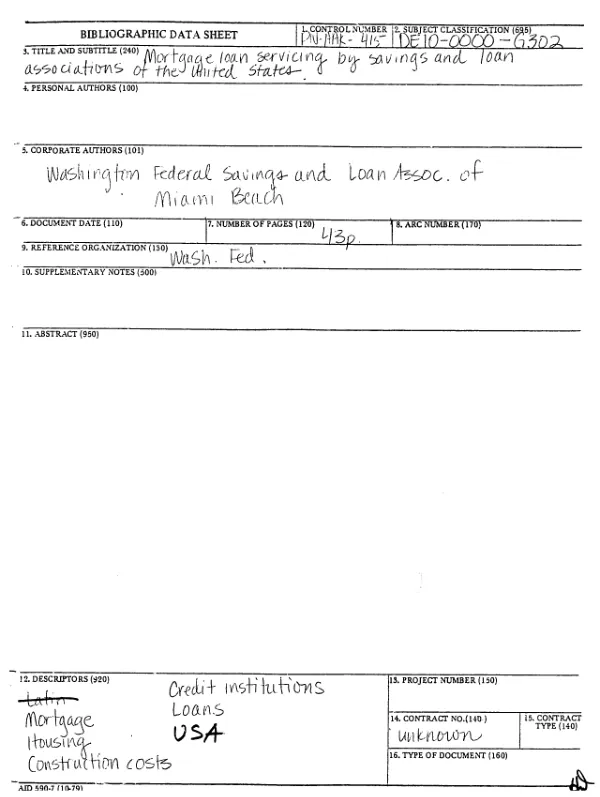
Abstract
In this brief manual, a synthesis of the general form in which mortgage loans are handled in Associations in the United States is presented, from the time the loan is requested until the mortgage is satisfied upon complete payment of the principal, interest, and other obligations. The procedure used by many Associations for processing loans is a simple, practical, and speedy one, and is used by Associations from the moment the prospective mortgagor requests a loan until said mortgagor accepts. This procedure is divided into three categories: customer contact, loan commitment, and acceptance. Customer contact is the initial contact made by the prospective mortgagor with the Association loan officer to discuss possibilities of obtaining a loan. In most cases, this contact commences when the mortgagor requests to see the Association loan officer to discuss possibilities of obtaining a loan. The loan application is the key that opens the process whereby a loan may be granted, and in substance, must contain all the information concerning the applicant, the property, and the type of loan requested. This information must be clear, simple, and as detailed as possible. Making a home loan is one of the most important transactions entered into by the average person during his lifetime, and the Association uses this first contact to obtain all information necessary to arrive at a decision. This, at the same time, gives the applicant the opportunity to become acquainted with the services offered by the Association. The Association should inform the applicant about the terms and conditions of the loan best suited to his needs. It is essential that the Association ascertain that the prospective mortgagor can afford to purchase the property at the stated price and can afford to pay the monthly installments and other charges and expenses. It is also important that the Association determine that the property is good and adequate security for the loan, and that all the other conditions concerning the loan are local. There are two types of loan applications: the formal and informal. The informal application is taken by telephone for submission to the Appraisal Department, and thereafter, based on the information obtained, the loan commitment is offered. A formal application is completed when the prospective mortgagor applies for a loan commitment. When the commitment is given and accepted by the applicant, it then becomes an integral part of the loan records. Many of the difficulties that are likely to arise can be avoided in the initial contact with the customer. The Association should inform the applicant about the approximate cost of the loan, the rate of interest, the term, the amount of the installments, and the time that will elapse before the application is approved and the corresponding instrument is executed. If the Association has particular fees or charges, these should be clearly explained to the applicant. The Association should also inform the applicant about the importance of the loan application and the need for accurate and complete information. In larger cities, contact is frequently made by telephone, by which means the Association secures the preliminary information required to complete the application. Also, in larger cosmopolitan cities, where loan competition is as keen or keener than in the savings field, a loan applicant may call four or five different Associations to obtain the loan commitment most favorable to him. The Association should be prepared to handle multiple loan applications and to provide clear and concise information to the applicant about the loan process and the terms and conditions of the loan.