POWER AFRICA
The Solar Home System Kick-Starter Program for Malawi
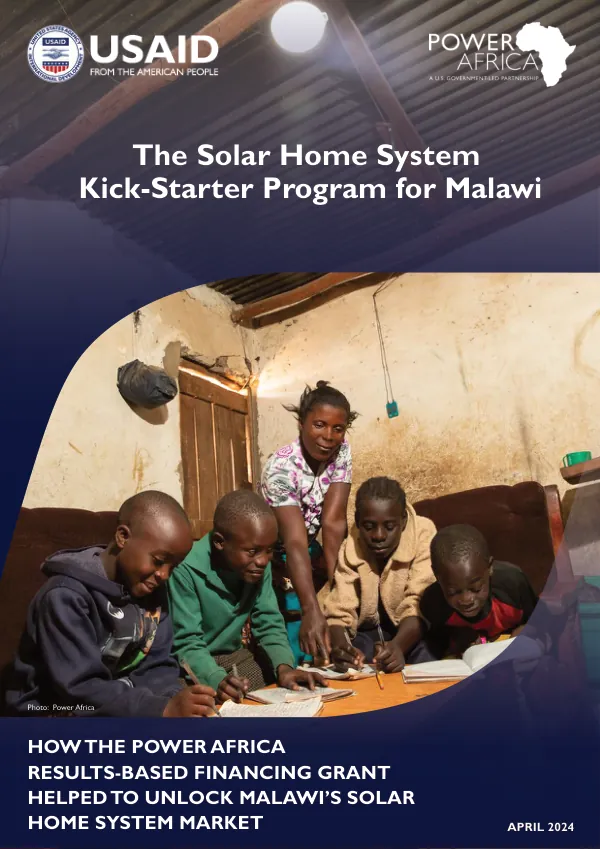
The Solar Home System Kick-Starter Program for Malawi was launched in 2019 by Power Africa to expand energy access, grow the private sector in the country, and attract qualified international solar home system players into the Malawian market.
2024 · 8 pages
Sign in to readA free account is required to download.
Abstract
The program aimed to provide affordable systems to local businesses and was designed to allow open participation to all qualified applicants. A total of 108,721 solar home systems were sold during the grant performance period from July 2019 to September 2022. A typical solar home system comprises a solar panel, battery, radio, and light bulbs. By placing the panel in sunlight during the day, the solar energy can be stored in a small battery and used to power lights and small appliances. The grant awarded up to $2 million in results-based funding and provided operational support to four Malawian solar home system companies: SolarWorks!, VITALITE, Yellow, and Zuwa Energy. The program was structured to provide 30% of the capital upfront to aid in the initial setup of the company, while the remaining 70% was structured to provide a fixed amount of funding per connection, where the amount of funding grows as the company sales volume increases. This structure incentivized players to rapidly ramp up sales to reach their targets. Companies were also offered operational support to assist in startup and sales support throughout the life of the program. To qualify for the Kick-Starter Program, solar home system companies needed to meet the following criteria: provide a boxed solar home system product that meets Lighting Global certification requirements, offer pay-as-you-go financing options, and satisfy the requirements of the USAID environmental self-assessment. The program selected solar home system companies with the highest scores against evaluation criteria in each application window. The evaluation criteria included qualification, technical evaluation, and financial evaluation. The technical evaluation score accounted for 70% of the overall score, while the financial evaluation score accounted for 30%. The overall score and selection were based on the technical evaluation score plus the financial evaluation score. Applications were ranked according to the overall score, and funds were allocated based on bidding requests until the funding ceiling was reached. The program secured partnerships with seven financiers, including FDH Bank, Kuwa Capital, and Standard Bank, who committed to reviewing grantees' working capital loan requirements and deciding on whether they would offer a loan and the terms of that loan. This decision process was independent of Power Africa, and the financiers were not obligated to provide loans. Other key partners included Energising Development and the Malawi Ministry of Energy. The Solar Home System Kick-Starter Program for Malawi has had a significant impact on the country's energy sector. The program has helped to increase access to energy, particularly in rural areas, and has created jobs and economic opportunities for local businesses. The program has also helped to promote the use of renewable energy and has contributed to the country's efforts to reduce greenhouse gas emissions. The program's success can be attributed to its innovative approach to financing and its focus on providing affordable energy solutions to local businesses. The program's results-based financing structure incentivized companies to rapidly ramp up sales and reach their targets, while the operational support provided to companies helped them to establish themselves in the market. The program's partnerships with financiers and other key stakeholders also helped to ensure the program's success. Overall, the Solar Home System Kick-Starter Program for Malawi has been a successful initiative that has helped to increase access to energy in the country. The program's innovative approach to financing and its focus on providing affordable energy solutions to local businesses have made it a model for other energy access programs in the region.
Related documents