NORC AT THE UNIVERSITY OF CHICAGO
The Sustainable Financing Initiative in Tanzania: At a Glance
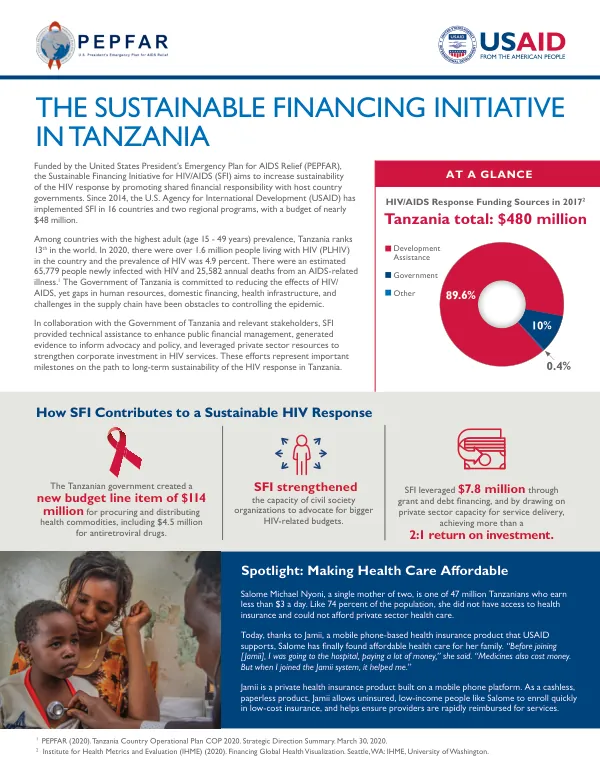
The Sustainable Financing Initiative (SFI) in Tanzania aims to increase the sustainability of the HIV response by promoting shared financial responsibility with the host country government.
2021 · 2 pages
Sign in to readA free account is required to download.
Abstract
Funded by the United States President's Emergency Plan for AIDS Relief (PEPFAR), SFI has been implemented in 16 countries and two regional programs since 2014, with a budget of nearly $48 million. Tanzania has one of the highest adult HIV prevalence rates in the world, with over 1.6 million people living with HIV (PLHIV) in 2020. The Government of Tanzania is committed to reducing the effects of HIV/AIDS, but gaps in human resources, domestic financing, health infrastructure, and supply chain challenges have hindered progress. In collaboration with the Government of Tanzania and relevant stakeholders, SFI provided technical assistance to enhance public financial management, generated evidence to inform advocacy and policy, and leveraged private sector resources to strengthen corporate investment in HIV services. SFI's efforts have contributed to a new budget allocation of $114 million per year in 2016 and 2017 to purchase and deliver essential health commodities, including a first-ever allocation of $4.5 million to purchase antiretroviral drugs. Disbursements of these new budget line items were limited, indicating the need for greater investments in public financial management. To improve resource use and the availability of essential health commodities, additional efforts will be needed to address spending challenges such as misalignment of budgets to government revenues, procurement limits for relevant supplies and products, and the priority given to non-health sectors over health. SFI also focused on building the capacity of government institutions and civil society organizations to improve how HIV funds are allocated and actually spent, ensuring continued domestic funding for HIV post-SFI. As a result of this initiative, funds have been channeled to country-led efforts to further mobilize domestic resources to address the needs of PLHIV. Private sector engagement was another key area of focus, with SFI building the capacity of the private sector to increase affordability and availability of services for PLHIV. This included partnering with Jamii Africa and other private companies to enroll PLHIV in private insurance, making health care more affordable and accessible. SFI's achievements in Tanzania include unlocking innovative financing to help private HIV service providers access private capital, coaching 70 facilities on loan application processes, and helping develop business cases to incentivize lending. As a result, providers were able to apply for other private loans without a guarantee, and SFI leveraged $6.4 million in loans from CRDB Bank to health facilities, including $1.7 million to expand HIV services. SFI also promoted affordable HIV care through private health insurance, enrolling over 10,000 more people in private healthcare insurance through Jamii mobile insurance.