NORC AT THE UNIVERSITY OF CHICAGO
The Sustainable Financing Initiative in Uganda
The Sustainable Financing Initiative (SFI) in Uganda aims to increase the sustainability of the country's HIV response by promoting shared financial responsibility with the host country government.
2021 · 2 pages
Sign in to readA free account is required to download.
Abstract
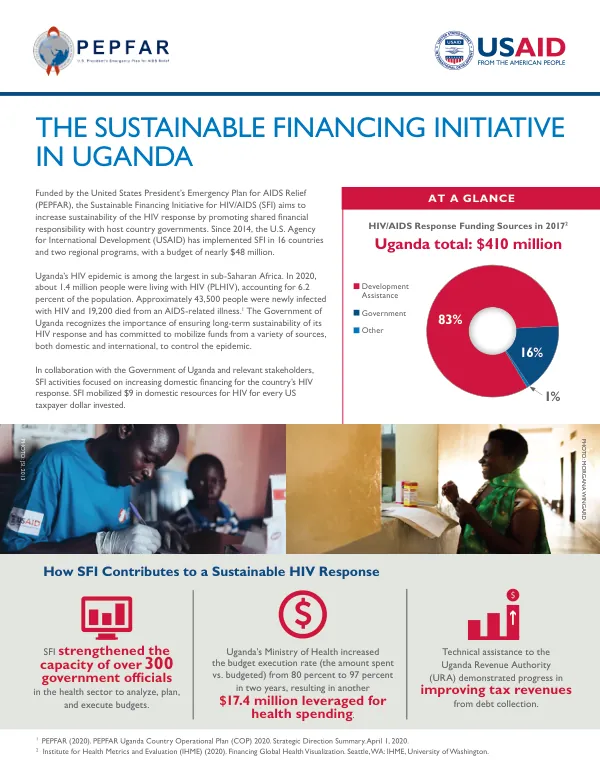
Funded by the United States President's Emergency Plan for AIDS Relief (PEPFAR), SFI has been implemented in Uganda since 2014 with a budget of nearly $48 million. The initiative focuses on increasing domestic financing for Uganda's HIV response, mobilizing $9 in domestic resources for HIV for every US taxpayer dollar invested. Uganda's HIV epidemic is among the largest in sub-Saharan Africa, with approximately 1.4 million people living with HIV (PLHIV) in 2020, accounting for 6.2 percent of the population. The Government of Uganda recognizes the importance of ensuring long-term sustainability of its HIV response and has committed to mobilizing funds from various sources, both domestic and international, to control the epidemic. In collaboration with the Government of Uganda and relevant stakeholders, SFI activities have strengthened the capacity of over 300 government officials in the health sector to analyze, plan, and execute budgets. SFI has contributed to a sustainable HIV response in Uganda by improving budget planning and spending at the local and national levels. The initiative supported the Ministry of Health's transition to program-based budgeting (PBB), which links the budget to results and health outcomes, making it easier to advocate for resources based on known needs. SFI trained more than 300 government officials in PBB, and the Ministry of Health increased the budget execution rate from 80 percent to 97 percent in two years, resulting in an additional $17.4 million leveraged for health spending. The initiative has also strengthened public financial management at the Ministry of Health by providing technical assistance, building capacity for budget planning, execution, and revenue collection, and generating evidence for decision-making. At the decentralized level, SFI supported 16 districts to roll out program-based budgeting, linking the budget to health outcomes. Uganda's high budget execution rates demonstrate the government's commitment to improved financial management, and the country has undertaken an activity-based costing and management (ABC/M) exercise to understand the cost of HIV services, improve program efficiency, and resource allocation for maximum impact. SFI's work demonstrates that investments in budget systems and planning can have long-term impacts for years to come and contribute to sustainable financing. The initiative's efforts have contributed to a greater than 9:1 return on investment by leveraging more resources from Uganda's government. Uganda's health sector was the first sector ever to submit a consolidated program-based budget, and SFI's efforts have contributed to a first-time mandate for all government ministries, departments, and agencies to budget for HIV/AIDS.