USAID DEC
The Use of Narrative for Behavior Change in Adolescent and Youth Sexual and Reproductive Health
Sign inFUTURES GROUP INTERNATIONAL, LLC
The Use of Narrative for Behavior Change in Adolescent and Youth Sexual and Reproductive Health
The use of narratives in behavior change programs for youth has gained significant attention in recent years due to their potential to motivate and support health behavior change in a more engaging and three-dimensional way than traditional communication approaches.
2015 · 8 pages
Sign in to readA free account is required to download.
Abstract
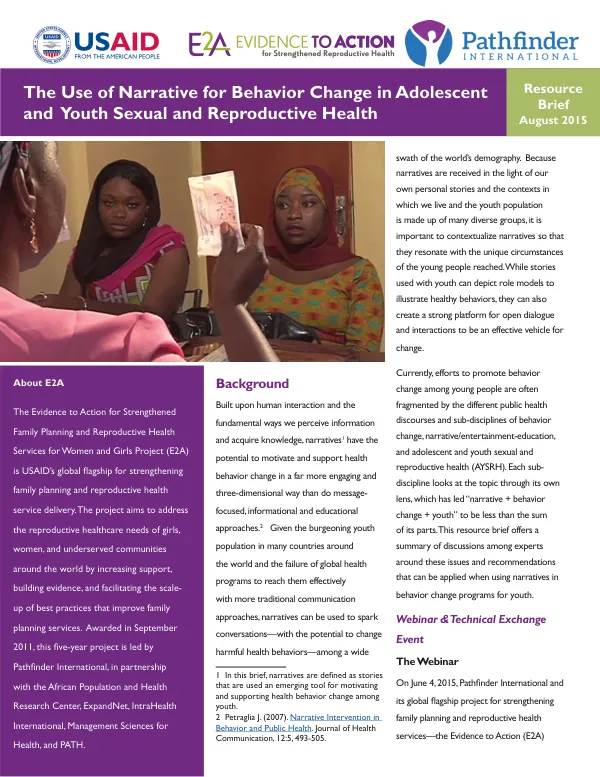
Narratives have been defined as stories used to motivate and support health behavior change among youth, and they can be used to spark conversations and change harmful health behaviors among a wide range of youth populations. The Evidence to Action (E2A) project, a global flagship for strengthening family planning and reproductive health service delivery, has been at the forefront of exploring the use of narratives in behavior change programs for youth. E2A has partnered with various organizations to co-host webinars and technical exchanges among experts in behavior change and adolescent and youth sexual and reproductive health (AYSRH). During a webinar titled "Whose Story is it Anyway? The Use of Narrative for Behavior Change in AYSRH," experts discussed the theoretical underpinnings and practical implications of addressing youth health needs through narratives. Cate Lane, USAID youth advisor, emphasized the need for participatory narratives that allow young people to challenge their own attitudes and beliefs as well as those of their communities. Regina Benevides, E2A's senior youth advisor, highlighted the complexity of AYSRH programs, which deal with sensitive topics, involve taboos, and are challenged by imbalanced gender, age, economics, and power dynamics. Joseph Petraglia, Pathfinder International's senior behavior change advisor, examined the different functions of narratives, including ads, parables, and inkblots. He noted that the inkblot approach, which encourages youth to share their own stories, can be a very effective method for responding to the heterogeneity of youth. Amy Hill, director of the Silence Speaks program with the Center for Digital Storytelling, emphasized the need to appropriately contextualize the story and train those who are presenting it. Following the webinar, a technical exchange meeting was held among 28 experts, who shared, examined, and analyzed approaches for using narrative to change sexual and reproductive health behaviors. The meeting identified guiding principles that can be applied by practitioners when developing, implementing, and evaluating narrative-focused behavior-change interventions. The guiding principles include conducting formative research with young people to ensure that any resultant narratives reflect their realities, engaging youth in a participatory manner throughout the entire development process, and identifying narrative type and purpose, and clearly laying out objectives and how they will benefit the target audience from the beginning. These principles can be applied to three stages of using narratives for behavior-change interventions: the development of the narrative itself, the implementation of the narrative intervention, and the evaluation of how the narrative was implemented. E2A is using the narrative in the film "Binta's Dilemma" as part of a comprehensive approach to behavior change that encourages conversations among young Nigeriens about culturally controversial topics, including contraception, unintended pregnancy, and the societal pressures on young women to bear children once they are married. The film provided a case study for how narrative is being used to change sexual and reproductive health behaviors and was a bridge to the technical exchange meeting that followed. In terms of developing narratives for youth, the creative process involves conducting formative research with young people to ensure that any resultant narratives reflect their realities. This process should be participatory and offer the youth involved practical skills, but also employ those with the necessary talents and abilities. Pretesting or concept testing with a segment of the population and adapting the narrative accordingly can be a useful approach to ensure the stories being delivered are appropriate in the local context. Practitioners leading the narrative development process should set clear objectives for the narrative and follow them, and they should have a realistic plan for how the narratives will be disseminated.