USAID
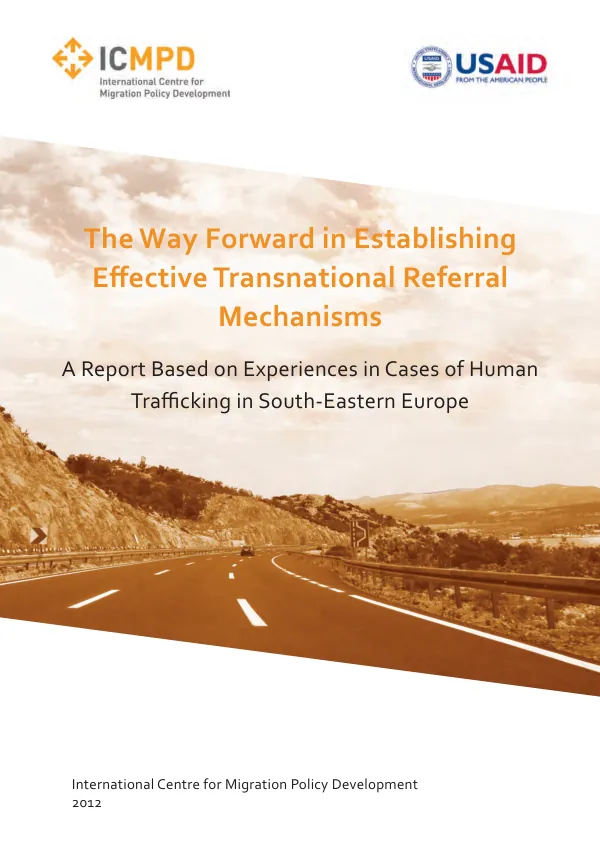
The Way Forward in Establishing Effective Transnational Referral Mechanisms
Transnational Referral Mechanisms (TRMs) for human trafficking in South-Eastern Europe have been a key focus for the International Centre for Migration Policy Development (ICMPD) since 2006.
2012 · 162 pages
Sign in to readA free account is required to download.
Abstract
With funding from the United States Agency for International Development (USAID) and the European Commission, ICMPD has worked with governments from the European Union and South-Eastern Europe to implement a TRM for trafficked persons. This effort has led to the development of comprehensive anti-trafficking legislative and operational tools, as well as the ratification of international and regional anti-trafficking instruments. The TRM Standard Operating Procedures (SOPs) have been developed to facilitate cross-border cooperation in cases of human trafficking. The SOPs outline the steps to be taken by law enforcement agencies, prosecutors, and social workers in responding to trafficking cases. However, the implementation of the SOPs has been hindered by a lack of capacity development initiatives, particularly in the areas of legislation, good governance, communication, and capacity development. A report by ICMPD, "The Way Forward in Establishing Effective Transnational Referral Mechanisms," highlights the need for improved transnational cooperation in the fight against human trafficking. The report is based on experiences in cases of human trafficking in South-Eastern Europe and provides practical recommendations for countries that have yet to establish a TRM. The report emphasizes the importance of translating theory into practice and highlights the need for efficient cross-border cooperation in protecting trafficked persons. The report identifies several challenges to effective transnational cooperation, including a lack of coordination between national and transnational referral mechanisms, inadequate legislation, and insufficient capacity development initiatives. To address these challenges, the report provides recommendations on legislation, good governance, communication, and capacity development. The report also highlights the importance of reporting templates and thematic focus areas, such as trafficking for labor exploitation and child trafficking. The TRM Guidelines have been developed to provide a framework for the implementation of the TRM SOPs. The guidelines outline the key principles and procedures for effective transnational cooperation in cases of human trafficking. The guidelines emphasize the importance of good governance, communication, and capacity development in ensuring the effective implementation of the TRM SOPs. The report concludes that the establishment of effective transnational referral mechanisms is crucial in the fight against human trafficking. The report emphasizes the need for improved transnational cooperation and provides practical recommendations for countries that have yet to establish a TRM. The report highlights the importance of translating theory into practice and emphasizes the need for efficient cross-border cooperation in protecting trafficked persons. The ICMPD team, including Radka Kristýna Chobotová, Melita Gruevska-Graham, Anders Lisborg, Elena Petreska, Martijn Pluim, Mariyana Radeva Berket, Madalina Rogoz, Pratima Sood, Brigitte Stevkovski, and Elisa Trossero, contributed to the drafting of the report. The report also acknowledges the contributions of key informants from governmental and non-governmental agencies, as well as international organizations working in the South-Eastern Europe region. The report provides a comprehensive overview of the TRM SOPs and the challenges to their implementation. The report highlights the importance of improved transnational cooperation and provides practical recommendations for countries that have yet to establish a TRM. The report emphasizes the need for efficient cross-border cooperation in protecting trafficked persons and highlights the importance of translating theory into practice. The report is organized into several sections, including an introduction, a discussion of transnational referral mechanisms, and a review of international cooperation in cases of human trafficking. The report also provides a summary of the key findings and recommendations, as well as a list of tables and boxes that provide additional information on the TRM SOPs and the challenges to their implementation. The report highlights the importance of good governance, communication, and capacity development in ensuring the effective implementation of the TRM SOPs. The report emphasizes the need for improved transnational cooperation and provides practical recommendations for countries that have yet to establish a TRM. The report concludes that the establishment of effective transnational referral mechanisms is crucial in the fight against human trafficking. The report is a valuable resource for policymakers, practitioners, and researchers working in the field of human trafficking. The report provides a comprehensive overview of the TRM SOPs and the challenges to their implementation. The report highlights the importance of improved transnational cooperation and provides practical recommendations for countries that have yet to establish a TRM. The report emphasizes the need for efficient cross-border cooperation in protecting trafficked persons and highlights the importance of translating theory into practice.