USAID DEC
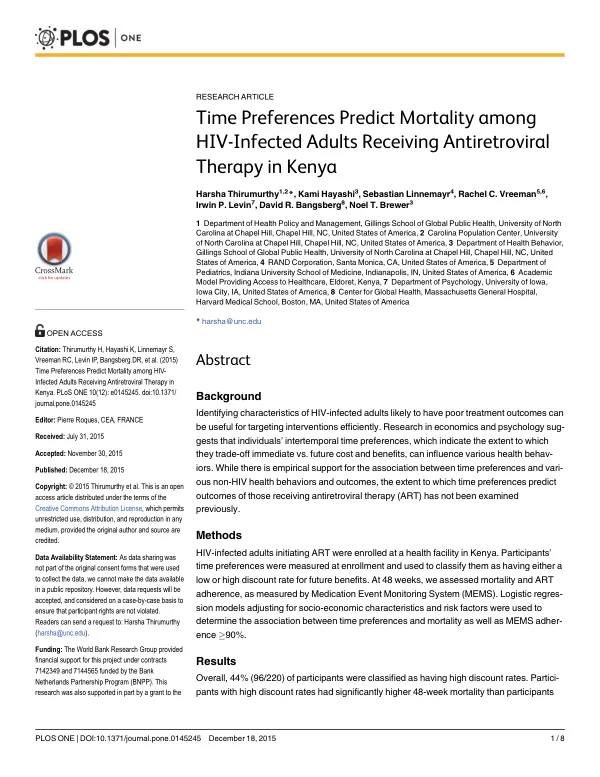
Time Preferences Predict Mortality among HIV-Infected Adults Receiving Antiretroviral Therapy in Kenya
Sign inUNIVERSITY OF NORTH CAROLINA AT CHAPEL HILL
Time Preferences Predict Mortality among HIV-Infected Adults Receiving Antiretroviral Therapy in Kenya
HIV-infected adults initiating antiretroviral therapy (ART) in Kenya were enrolled in a study to examine the association between their time preferences and mortality and ART adherence.
2015 · 8 pages
Sign in to readA free account is required to download.
Abstract
Time preferences, which indicate the extent to which individuals trade-off immediate versus future costs and benefits, were measured at enrollment and used to classify participants as having either a low or high discount rate for future benefits. A total of 220 participants were enrolled in the study, with 44% classified as having high discount rates. Participants with high discount rates had significantly higher 48-week mortality than those with low discount rates, with an adjusted odds ratio of 3.84 (95% CI 1.03, 14.50). In contrast, MEMS adherence 90% was similar for participants with high versus low discount rates, with an adjusted odds ratio of 0.70 (95% CI 0.40, 1.25). The study was conducted within a randomized controlled trial that tested whether mobile phone text messages improved ART adherence. The study site was a government-run health facility in Kenya's Nyanza region, where the USAID-Academic Model Providing Access to Healthcare (AMPATH) provided free comprehensive care to HIV-infected patients. Patients who were aged >18 years, HIV-infected, and either initiating ART at the time of enrollment or had initiated ART within the past 3 months were eligible to participate in the RCT. The study procedures have been described in greater detail previously. At the time of enrollment, participants completed a survey that assessed demographic characteristics and time preferences. Study staff at the clinic's pharmacy transferred one of their three antiretroviral medications to a pill bottle equipped with a Medication Event Monitoring System (MEMS) cap that electronically recorded the date and time of each opening. Participants were followed for 48 weeks after enrollment, and the Institutional Research Ethics Committee of the Moi University School of Medicine and the Institutional Review Boards of Georgetown University and the University of North Carolina at Chapel Hill approved the study. The study's findings suggest that high discount rates are associated with significantly higher risk of mortality among HIV-infected patients initiating ART. Greater use of time preference measures may improve identification of patients at risk of poor clinical outcomes. More research is needed to further identify mechanisms of action and to build upon and test the generalizability of this finding. The study's results have implications for the development of interventions to improve ART adherence and reduce mortality among HIV-infected patients. By identifying patients with high discount rates, healthcare providers may be able to target interventions to improve their adherence to ART and reduce their risk of mortality. The study's findings also highlight the importance of considering time preferences in the development of interventions to improve health outcomes among HIV-infected patients. The study was funded by the World Bank Research Group and the USAID-Academic Model Providing Access to Healthcare Partnership from the United States Agency for International Development as part of the President's Emergency Plan for AIDS Relief (PEPFAR). The study's authors have declared that no competing interests exist.
Related documents