USAID DEC
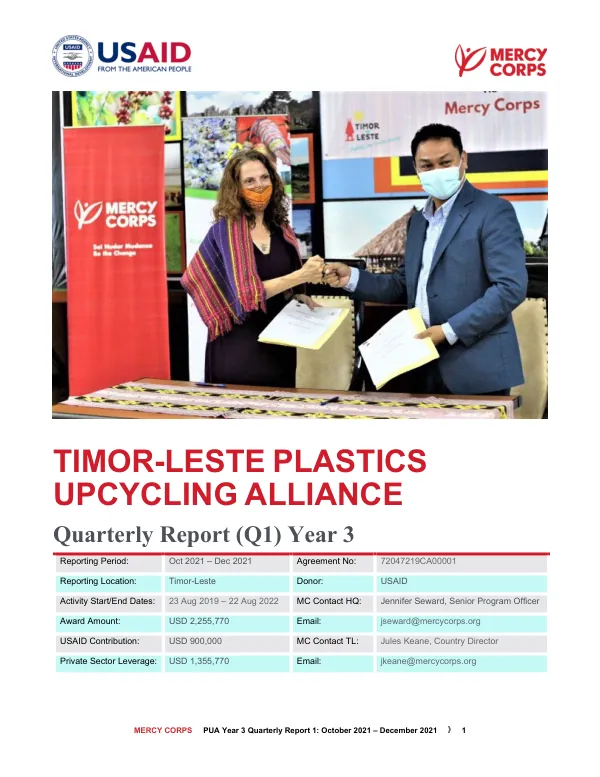
Timor-Leste Plastics Upcycling Alliance (PUA) Year 3 Quarterly Report 1: October 2021 – December 2021
Sign inMERCY CORPS INTERNATIONAL
Timor-Leste Plastics Upcycling Alliance (PUA) Year 3 Quarterly Report 1: October 2021 – December 2021
The Plastics Upcycling Alliance (PUA) is a 3-year, $2.25 million activity to sustainably address plastic waste management in Timor-Leste.
2021 · 18 pages
Sign in to readA free account is required to download.
Abstract
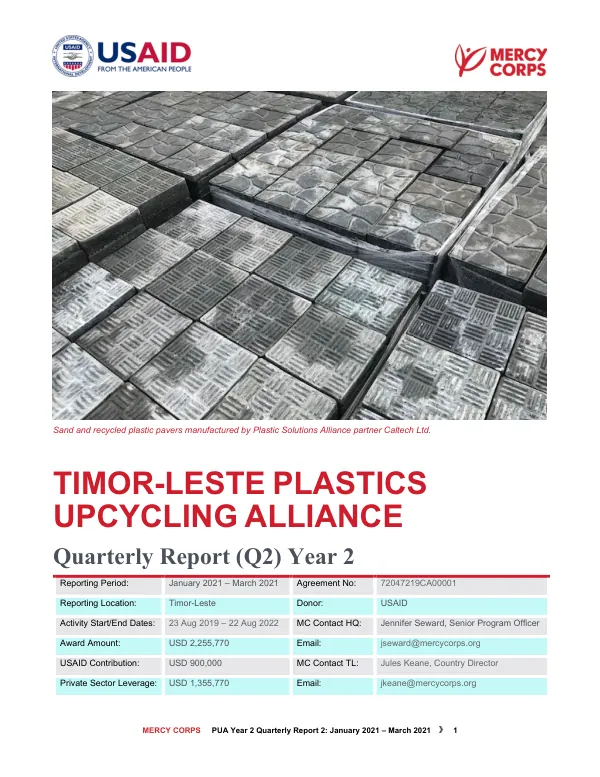
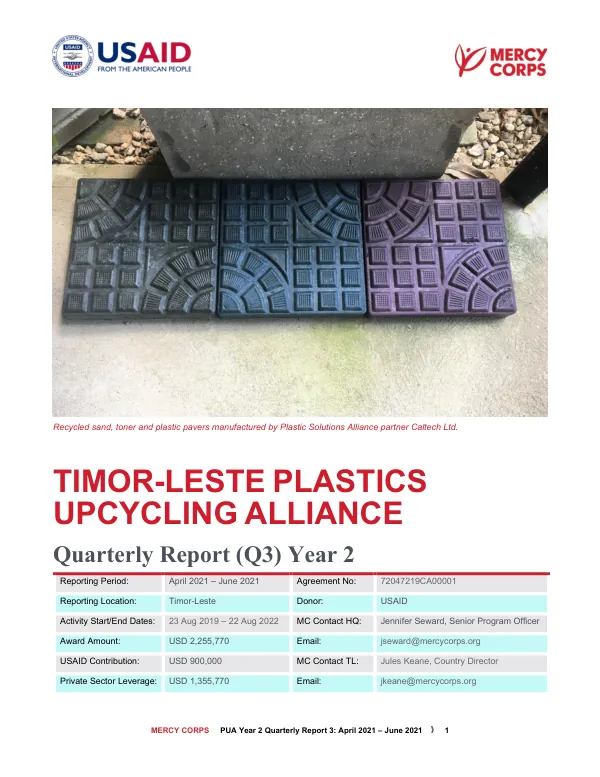
PUA works to address both the challenge of excessive plastic waste and the potential to develop a competitive 'plastics circular economy' in Timor-Leste. The PUA is funded through a $900,000 investment from USAID, with an additional $1.35 million from private-sector investment. Timor-Leste, a country in Southeast Asia, became independent in 2002 after decades of conflict. The country faces significant challenges, including extreme poverty and hunger, as well as ongoing threats of conflict and violence. Despite progress in reducing poverty levels, the proportion of Timorese living in poverty remains high, at an estimated 42% in 2014. Economic growth has centered on Timor-Leste's natural resources, with oil accounting for over 90% of government revenues. This growth has resulted in a rise in waste production, including plastic waste. Dili, Timor-Leste's capital, faces the urgent challenge of addressing excessive amounts of plastic waste while lacking a feasible recycling solution. Currently, mismanaged plastic is burned in rubbish piles throughout the city, clogs critical drainage infrastructure, and is washed up on the country's once pristine beaches. This creates risks to human health and safety and jeopardizes the growth potential of its nascent but promising tourism industry. The PUA catalyzes the growth of a plastics recycling industry, creating and expanding valuable employment and entrepreneurship opportunities with the potential to improve the natural beauty of Timor-Leste and protect the health and safety of its people. PUA's goal is to assist Timor-Leste to achieve 'plastic neutral' status whereby unnecessary plastic use is curtailed and replaced, and up to 20% of Dili's plastic waste is collected and recycled into locally sought-after products within three years. The technical approach is built on the premise of multi-tiered stakeholder participation in the plastics recycling industry, whereby plastic by-products are collected from businesses and industry actors; waste contractors collect and sell plastic waste from community recycling bins; and waste pickers collect plastic waste directly from households, as well as discarded plastic waste in the community. Once collected, the plastic waste will be sold to aggregators and micro-processors, who aggregate, clean, sort, and/or shred plastics, creating a value-added product for sale onwards to upcyclers and asphalt producers. Key achievements of Quarter 1, Year 3 include strengthening cooperation with government to inspire policy reform, building partnerships for the piloting of plastic asphalt technologies, and exploring new collaboration opportunities under the Plastics Solutions Alliance. PUA also tested product lines to assess the potential for international exports, with three pallets of recycled pavers made from local plastic waste exported to Australia and one additional pallet to Canada. The PUA works closely with the Government of Timor-Leste and local stakeholders to support a policy environment that fosters the plastics waste industry while also establishing a model of plastics management for dissemination beyond Dili. Initially, the activity will target Dili, the capital city of Timor-Leste, and the largest population and plastic waste concentration center. Opportunities to expand plastic waste supply chains, as well as product distribution networks, will be considered at a later stage if feasible and relevant to PUA's core objectives.
Related documents