MERCY CORPS INTERNATIONAL
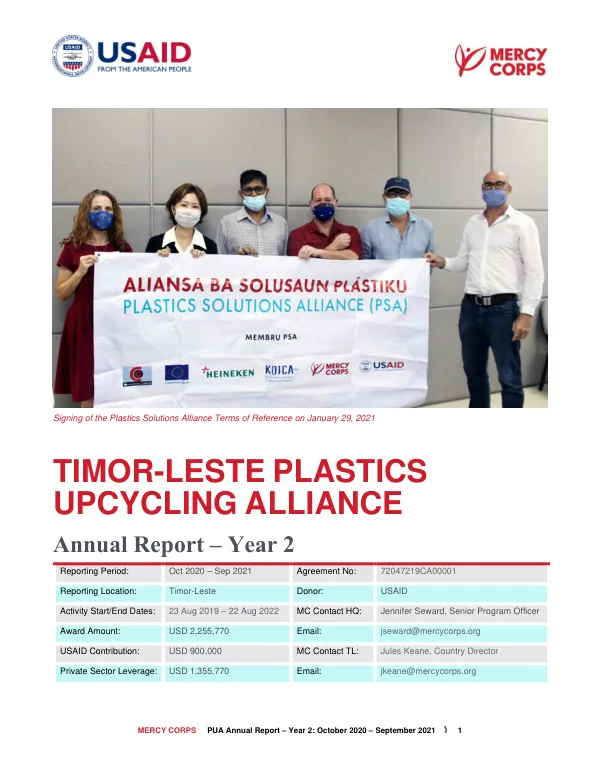
PUA Annual Report – Year 2: October 2020 – September 2021
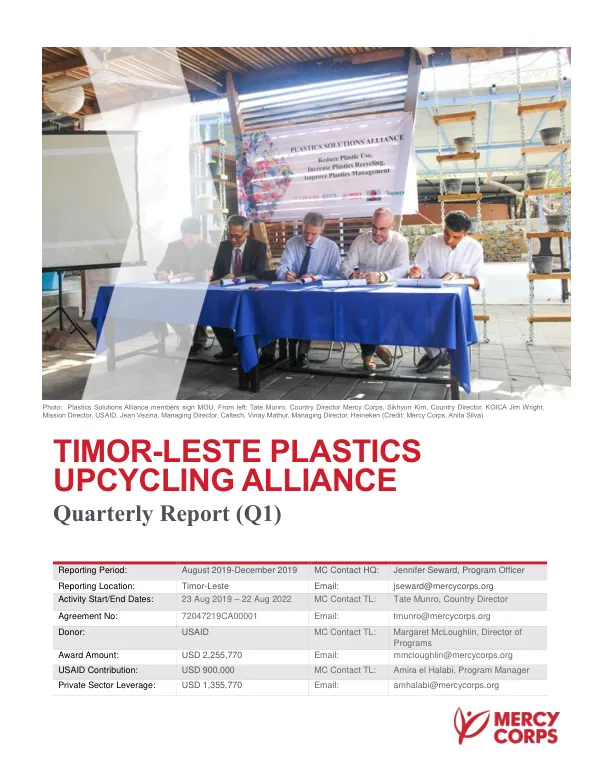
The Plastics Upcycling Alliance (PUA) is a 3-year, $2.25 million activity to sustainably address plastic waste management in Timor-Leste.
2021 · 15 pages
Sign in to readA free account is required to download.
Abstract
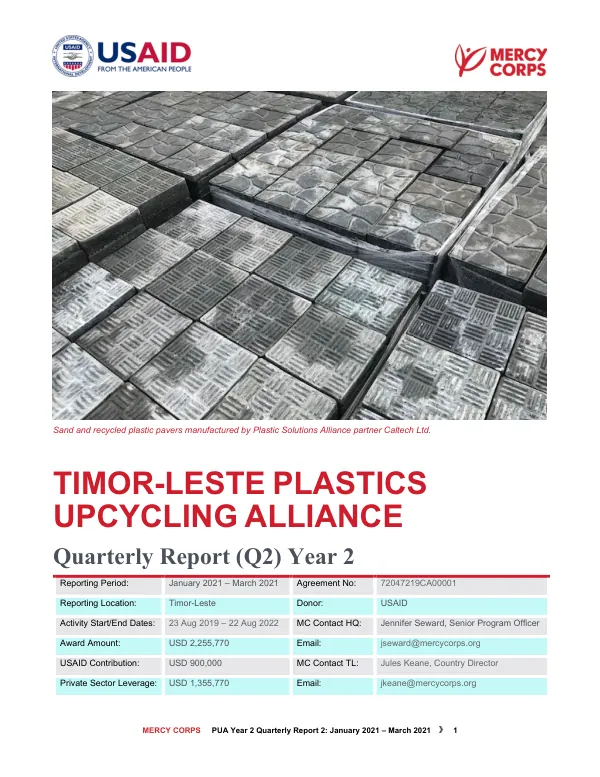
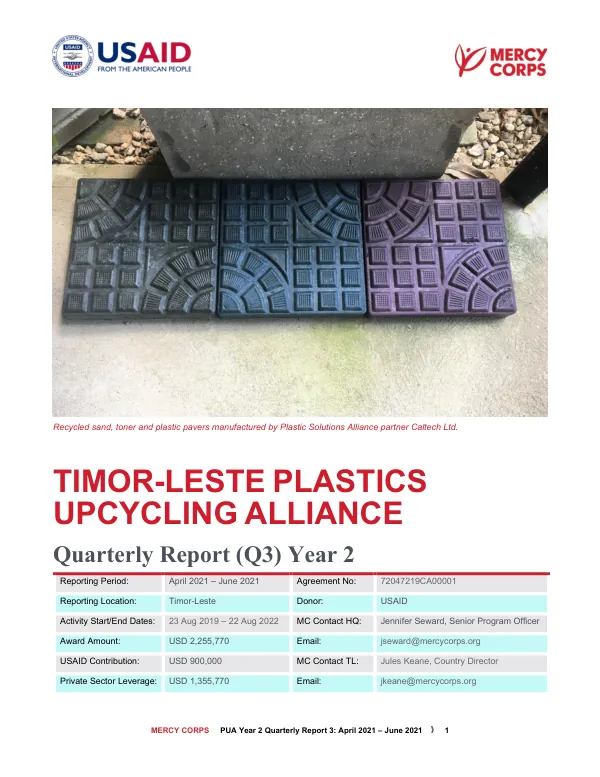
PUA works to address both the challenge of excessive plastic waste and the potential to develop a competitive 'plastics circular economy' in Timor-Leste. The PUA is funded through a $900,000 investment from USAID, with an additional $1.35 million from private-sector investment. Key achievements of Year 2 include training upcycled and plastic alternative product businesses. PUA worked in partnership with the United Nations Development Programme (UNDP) to collaborate on a Social Business Camp Training, a multi-day training event attended by five local recycling and upcycling businesses identified and referred by PUA. As part of the learning process, the participants began the preparation of their business plans and were able to fill applications for additional support through the program. Collaborating to support the circular economy and a local CSO was another key achievement. As part of their joint work under guidance from US Army Pacific to support local civil society, Task Force Oceania and members of the US Navy Seabees delivered recycled plastic pavers made by PUA partner Caltech to Casa Vida, a shelter for victims of gender-based violence in Dili. The pavers were donated in concert with the Office of Defense Cooperation of US Embassy Timor-Leste. Promoting local upcycled and plastic alternative products was also a significant achievement. In December 2020, PUA joined forces with Alola Foundation, an NGO focused on women's empowerment and support for businesses, for the organization of Alola's annual Christmas Fair. For the first time, the fair showcased the work of local social enterprises and entrepreneurs making objects from upcycled plastic and alternatives to single-use plastic. Piloting an integrated plastic waste collection system was another key achievement. In March 2021, Mercy Corps launched the piloting of a private sector-driven plastic waste collection service in Dili. Despite exceptional circumstances during the start-up phase, marked by devastating floods and prolonged COVID-19 restrictions that resulted in the closure of several participating institutions, the service maintained its operations and completed weekly end-to-end collection rounds, from each bin to the recycling station. Expanding engagement with road construction actors was also a significant achievement. Road and infrastructure construction is key to create a market for building materials integrating recycled plastic waste. Mercy Corps increased its coordination and advocacy efforts with targeted government stakeholders involved in transport, public works and construction standards, to advocate for the introduction of recycled content requirements and the use of plastic asphalt in planned road developments and upgrades. Analyzing global best practice and connecting with global initiatives was another key achievement. Mercy Corps led extensive research to analyze global best practices in the development of recycling supply chains and upcycled product lines, with a focus on applicability in Timor-Leste. Through these discussions, Mercy Corps intended to examine how international stakeholders may have tackled some of the market, technical, and regulatory barriers the program is faced with, and to explore opportunities to link PUA's efforts to global markets and coalitions. The PUA has made significant progress in creating a circular economy for plastic waste, expanding employment and entrepreneurship opportunities, while protecting the natural beauty of Timor-Leste and health and safety for its people. The activity has supported 33 income-generating opportunities in the Plastics Circular Economy as a result of its assistance. The quantity of plastic recycled/upcycled into locally sought-after products as a result of the activity's assistance is 18.53 tons, with an expected increase with the commissioning of commercial scale machinery.