USAID DEC
Tips for USAID Biodiversity Activity Start-Up (Steps 3-5): Using Results Chains to Develop an Activity Work Plan and Mel Plan
Sign inUSAID
Tips for USAID Biodiversity Activity Start-Up (Steps 3-5): Using Results Chains to Develop an Activity Work Plan and Mel Plan
Theory of Change (TOC) is a conceptual framework used to describe how an activity or program will achieve its intended results.
2018 · 6 pages
Sign in to readA free account is required to download.
Abstract
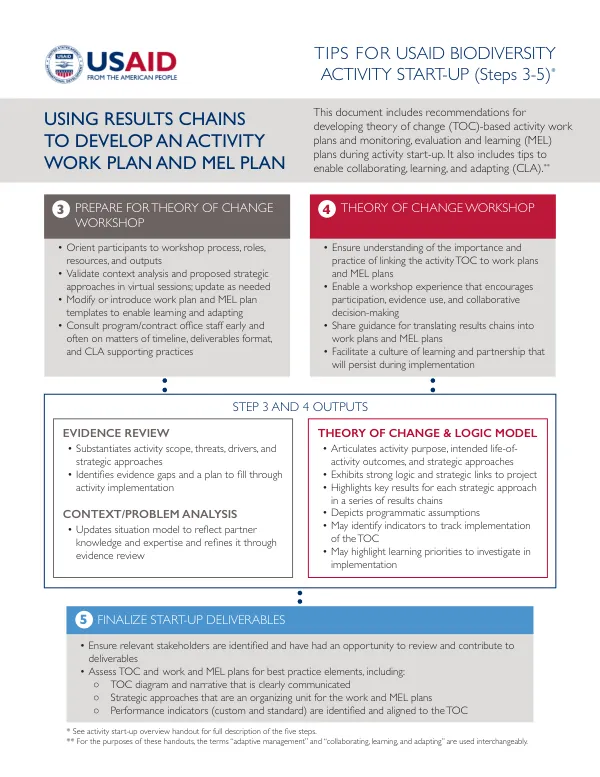
In the context of USAID biodiversity activities, a TOC is used to guide the development of an activity work plan and monitoring, evaluation, and learning (MEL) plan. The TOC is a logical model that outlines the relationships between the activity's purpose, outcomes, outputs, and programmatic assumptions. The development of a TOC-based activity work plan and MEL plan involves several key steps. First, a theory of change workshop is conducted to orient participants to the workshop process, roles, resources, and outputs. The workshop validates the context analysis and proposed strategic approaches in virtual sessions and updates them as needed. The workshop also modifies or introduces work plan and MEL plan templates to enable learning and adapting. The theory of change workshop ensures that participants understand the importance and practice of linking the activity TOC to work plans and MEL plans. The workshop enables a collaborative decision-making process that encourages participation, evidence use, and learning. The workshop also shares guidance for translating results chains into work plans and MEL plans. The outputs of the theory of change workshop include an evidence review, context/problem analysis, and theory of change and logic model. The evidence review substantiates the activity scope, threats, drivers, and strategic approaches. The context/problem analysis updates the situation model to reflect partner knowledge and expertise and refines it through evidence review. The theory of change and logic model articulate the activity purpose, intended life-of-activity outcomes, and strategic approaches. The final step in developing a TOC-based activity work plan and MEL plan is to finalize the start-up deliverables. This involves ensuring that relevant stakeholders have had an opportunity to review and contribute to the deliverables. The TOC and work and MEL plans are assessed for best practice elements, including a clear TOC diagram and narrative, strategic approaches that are an organizing unit for the work and MEL plans, and performance indicators that are identified and aligned to the TOC. A CLA-ready work plan may include a clear theory of change, efforts to socialize the activity's TOC with key stakeholders, a management approach section that details specific actions and outputs to facilitate USAID and partner learning and adapting, tasks that engage local actors in learning and adapting, sufficient staff, capacity, budget, and time to execute programmatic actions and facilitate learning, and plans to pause and reflect on Year 1 to inform Year 2 work planning. The development of a TOC-based MEL plan involves understanding, agreeing to, and sharing a common vision of the MEL planning methodology and process, priority information, evidence needs, and audiences, MEL investments and outputs, monitoring and evaluating for both accountability and learning, and MEL plan centered around a TOC, not a list of indicators. The MEL plan should also include key outcomes and related indicators, programmatic assumptions that may be tested during implementation, and a clear understanding of the programmatic and mission context, recognition and accommodation of the actors involved and their monitoring and learning priorities, and understanding of what capacity, mission culture, host country norms, and financial and human resources exist for monitoring and learning. In translating results chains into an MEL plan, the activity's theory of change is the conceptual framework and underpinning for identifying relevant performance and context indicators. Performance and context indicators work together to monitor and report on the activity purpose, outcomes, outputs, and programmatic and context assumptions. Once indicators are prioritized and selected, the next step is to populate a TOC-informed indicator table and monitoring plan. The MEL plan should include a performance indicator summary table (PIST), data collection and analysis plan, roles and responsibilities, external and internal evaluations, evaluation methodology considerations, learning agenda, audience, and information needs, CLA methodology considerations, pause, pivot, and proceed/pause and reflect schedule, performance indicator tracking table (PITT), performance indicator reference sheets (PIRS), and results chain diagrams.
Related documents
Documents in this collection
 2017
2017USAID DEC
Foreign Assistance Act Sections 118 and 119 Tropical Forests and Biodiversity Analysis
Open record
USAID DEC
Design, Implementation, Monitoring, and Evaluation of Cross-Cultural HIV-Related Mental Health and Psychosocial Assistance Programs: A User’s Manual for Researchers and Program Implementers (Adult Version)
Open record