USAID. MISSION TO GUATEMALA
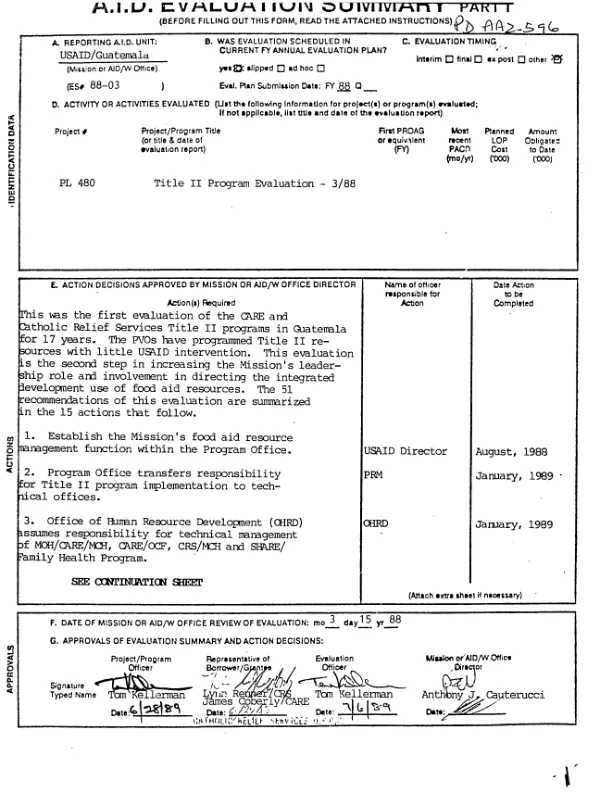
Title II program evaluation - 3/88
Summarizes the first evaluation (PD-AAY-678) in 17 years of CARE and CRS Title II programs in Guatemala, including maternal/child feeding, other child feeding, and Food for Work activities.
1989
Sign in to readA free account is required to download.
Abstract
(See also abstract of PD-AAY-678.) Major findings, conclusions, recommendations and lessons learned included: (1) Overall impact of Title II programs over time was hard to assess given the absence of baseline data and effective growth monitoring systems. (2) Title II food distribution has had a positive impact on family food intake and has resulted in beneficial income transfers as high as 25% in rural areas. Food distribution programs do not appear to necessarily produce high levels of dependence on food aid. (3) Food distribution can be a temporary incentive to help attract people to an unfamiliar service or beneficial activity. (4) The Mission must establish a Food Aid Management Office with the single priority of improving food aid management and food aid program development. (5) Program success depends on improved coordination between USAID/G"s technical offices and the PVO"s in the planning and implementation of food aid activities. (6) The Mission"s Title II program objectives and indicators need revision. (7) To be fully effective, food aid resources need to be better integrated with other USAID/G and GOG (Government of Guatemala) resources. (8) Increased GOG participation in all programs is required to assure long-term success. (Author abstract)
Connected topics
Related documents