WHO
Tool to estimate patients' costs - Guidelines interventions
TB Control in Low-Income Settings: Key Challenges and Interventions TB control in low-income settings faces significant challenges, including long patient delays, long health system delays, and high costs for patients.
2009 · 2 pages
Sign in to readA free account is required to download.
Abstract
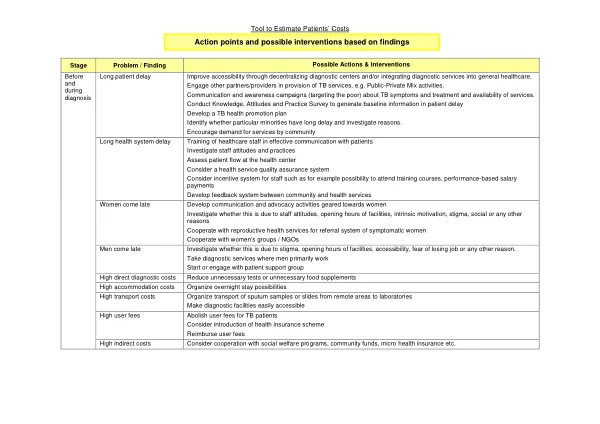
These challenges hinder effective TB control efforts and exacerbate the disease's impact on vulnerable populations. Long patient delays are a major issue, with patients often experiencing significant delays in seeking medical attention. To address this, decentralizing diagnostic centers and integrating diagnostic services into existing healthcare infrastructure is recommended. Additionally, engaging private providers through public-private partnerships can increase access to TB services. Community awareness campaigns targeting low-income populations can also help reduce delays by educating them about TB symptoms and treatment options. Health system delays, on the other hand, are also a significant concern. To mitigate this, healthcare staff training in effective communication with patients is essential. Investigating staff attitudes and practices can also help identify areas for improvement. Implementing a health service quality assurance system and providing incentives for staff to attend training courses or receive performance-based salary payments can also help reduce delays. Women and men often experience delays in seeking medical attention due to various reasons, including stigma, opening hours, and accessibility issues. To address this, communication and advocacy efforts geared towards women and men are necessary. Cooperating with women's groups and men's organizations can also help identify and address the root causes of these delays. High costs for patients is another significant challenge, with direct and indirect costs affecting patients' ability to access and complete TB treatment. To address this, reducing unnecessary tests and unnecessary food supplements can help decrease direct costs. Organizing overnight stay possibilities and making diagnostic facilities easily accessible can also help reduce accommodation and transport costs. Abolishing user fees for TB services and introducing health insurance schemes can also help reduce financial burdens on patients. During diagnosis, high indirect costs, including informal payments, can also be a challenge. To address this, TB drugs can be provided free of charge in public services, and measures can be taken to increase staff motivation and discourage informal payments. Providing food packages and cooperating with partners such as the World Food Program can also help reduce food costs. During treatment, high costs for patients can also be a challenge, including costs for non-TB medical care, transportation, and special foods. To address this, health insurance, micro insurance, and food packages can be provided to patients to reduce financial burdens. Cooperating with HIV programs for integrated services can also help reduce costs for non-TB medical care. In addition, many patients lose their jobs due to TB, highlighting the need for workplace programs to protect TB patients' employment rights. Organizing workplace programs, cooperating with labor organizations, and advocating with politicians can help mitigate this issue. Overall, addressing the challenges facing TB control in low-income settings requires a comprehensive approach that involves decentralizing diagnostic services, engaging private providers, and providing financial support to patients. By implementing these interventions, TB control efforts can be improved, and the disease's impact on vulnerable populations can be reduced.