USAID DEC
Tool to Estimate Patients’ Costs: Guidelines, Methods, Sampling, Interviewer Training
Sign inCDC
Tool to Estimate Patients’ Costs: Guidelines, Methods, Sampling, Interviewer Training
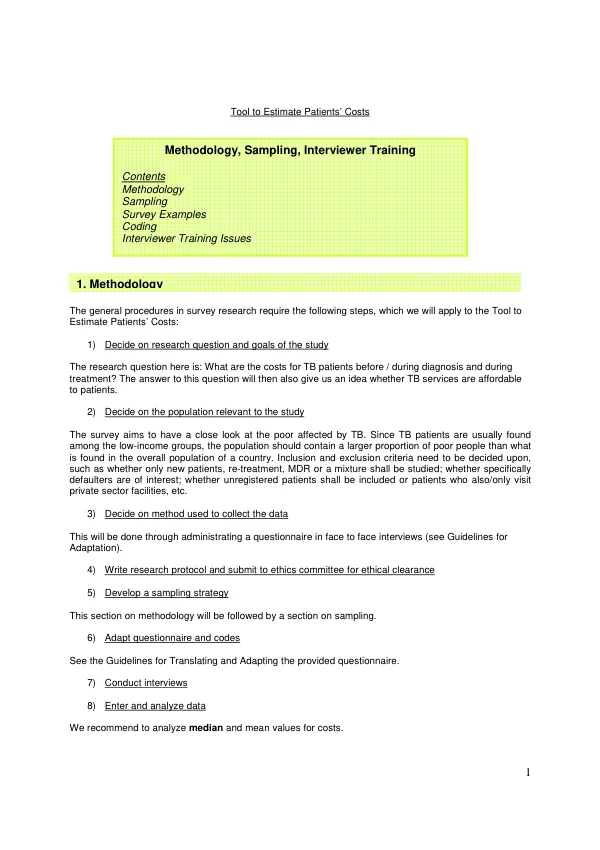
The Tool to Estimate Patients' Costs is a survey research methodology designed to assess the financial burden of tuberculosis (TB) patients, particularly those from low-income groups.
2009 · 6 pages
Sign in to readA free account is required to download.
Abstract
The research question focuses on determining the costs associated with TB diagnosis and treatment, with the aim of evaluating the affordability of TB services for patients. The survey targets poor TB patients, with a focus on new patients who have completed at least one month of treatment. The target group can be narrowed down to poor TB patients, and the sampling may take into account the prevalence of HIV in the region. The questionnaire is designed to be flexible, allowing for adaptation to local circumstances and the objectives of the survey. The sampling strategy involves selecting a subset of the population, which can be done through purposive or convenience sampling. Inferences about the studied population are limited to the selected district or province. The sample size can be determined based on the main indicators to be measured, the number of sites or mean costs, and the hypothesized proportions. The Tool to Estimate Patients' Costs uses a data entry template with the questions of the questionnaire for Epi Info, a free statistical software package. The template stores and analyzes the data, and subsequent data sets can be used in Excel and Access. The data entry process involves entering each completed questionnaire into the database, saving it for cleaning and later analysis. The survey will provide information on a subset of the population and can provide the basis for making inferences about the population. The sample is selected from a sampling frame, which is the total of the sampling units. Advice on sampling may be sought from the national statistics office. The Tool to Estimate Patients' Costs has been used in various studies, including a small survey in four counties in rural China and a study in Malawi. The study in Malawi involved selecting five health centers in urban Lilongwe, where patients in the intensive phase of treatment were systematically sampled from a list of new pulmonary TB patients. The survey results can be analyzed using median and mean values for costs. The Tool to Estimate Patients' Costs is a valuable resource for researchers and policymakers seeking to understand the financial burden of TB patients and to develop effective interventions to improve access to TB services. The methodology involves several steps, including deciding on the research question and goals of the study, deciding on the population relevant to the study, and deciding on the method used to collect the data. The survey involves face-to-face interviews, and the data entry process is facilitated by a data entry template for Epi Info. The Tool to Estimate Patients' Costs has several advantages, including its flexibility and adaptability to local circumstances and the objectives of the survey. The survey can be used to assess the financial burden of TB patients and to evaluate the affordability of TB services. The results of the survey can be used to inform policy and program decisions aimed at improving access to TB services.