USAID DEC
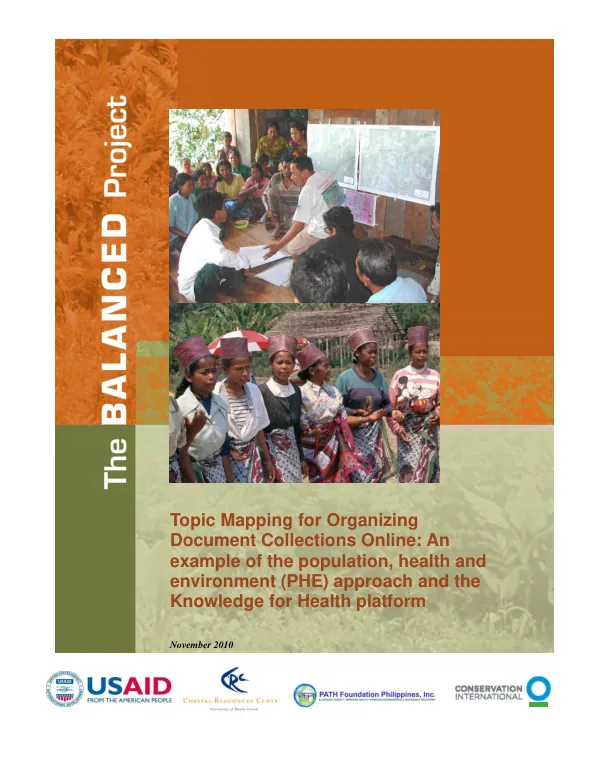
Topic Mapping for Organizing Document Collections Online: An example of the population, health and environment (PHE) approach and the Knowledge for Health platform
Sign inCOASTAL RESOURCES CENTER
Topic Mapping for Organizing Document Collections Online: An example of the population, health and environment (PHE) approach and the Knowledge for Health platform
The Building Actors and Leaders for Advancing Excellence in Community Development (BALANCED) Project is a five-year initiative supported by the U.S.
2010 · 18 pages
Sign in to readA free account is required to download.
Abstract
Agency for International Development (USAID) to promote and advance integrated Population, Health and Environment (PHE) approaches worldwide. The project's main objectives include synthesizing state-of-the-art knowledge and practices in PHE integration and disseminating that knowledge widely to diverse audiences in remote areas of critical biodiversity. The BALANCED Project has developed a PHE Toolkit, an online library of documents and resources on projects, policies, training materials, case studies, and research related to PHE. The toolkit is part of a larger set of health and development toolkits produced by the USAID-supported Knowledge for Health (K4Health) Project, managed by the Johns Hopkins University Center for Communication Programs (JHU/CCP). The PHE Toolkit provides a central repository for health, family planning, development, and conservation program managers and implementers, policymakers, researchers, academics, and educators to contribute their own PHE information and knowledge and easily locate and access the best of that contributed by others. The BALANCED Project PHE Toolkit Working Group employed a topic mapping technique to organize Toolkit resources and reach technical consensus. A topic map is a way to organize information so that it can be easily found, operating somewhat like a thesaurus by associating words with each other and offering examples of how the words are used. The topic map helps decide if the word or phrase is the right one for purposes and serves a similar function to a thesaurus for a collection of documents. The topic mapping process involved defining the subject focus of the topic map using topic-specific categories, assembling document titles and types of material from the previous PHE website, analyzing contents of documents to determine key words and phrases, listing frequently used terms and compound phrases from the PHE document collection, comparing topic lists or thesauri with the actual documents in hand, creating a thesaurus scheme to identify PHE terms broader or narrower than each other, re-examining documents and materials and assigning to tab and sub-tab headings, and having domain experts and potential Toolkit users review tab headings/sub-headings. The PHE Toolkit is structured into eight tabs: WHY PHE?, PHE APPROACHES, CURRENT PHE PROGRAMS, COMMUNICATIONS, OUTREACH, AND ADVOCACY, CAPACITY BUILDING AND FIELD-BASED RESOURCES/TOOLS, COUNTRY/REGIONAL EXPERIENCE, GLOBAL ANALYSIS AND ASSESSMENT, and EMERGING ISSUES IN PHE. The toolkit provides a logical, evidence-based framework for organizing PHE information and resources, making it easier for users to find and access relevant content. The BALANCED Project's process for organizing PHE information and resources is described in this document, which aims to reach people familiar with PHE concepts and themes, as well as those interested in creating knowledge management (KM) type toolkits on the USAID-supported Knowledge for Health (K4Health) site. The document complements the technical guidance for toolkit development provided by the K4Health Project and references guides developed by the USAID-supported Knowledge for Health (K4Health) Project.