USAID. MISSION TO NEPAL
Trail suspension bridges
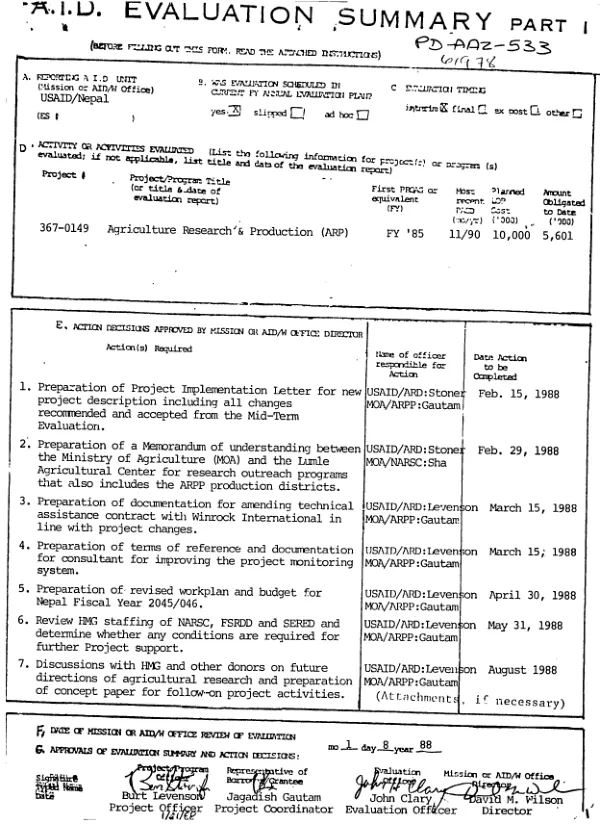
Evaluates project to strengthen the capacity of Nepal"s Suspension Bridge Division (SBD) to construct and maintain trail suspension bridges.
Lacoul, S.; Nance, W. B. · 1981
Sign in to readA free account is required to download.
Abstract
PES covers the period 9/79-7/81 (but includes observations through 1/82) and is based on document review and interviews with project officials. Targets have been largely met. As of 1/82, 9 bridges have been built and 9 others partially completed (vs. a targeted 24-36 completed); 16 others are in the planning stage. A site surveying manual was developed, but not in time to be used by the SBD in completing 38 site surveys (vs. 25 planned). The manual will be used, however, in surveying some of the 900 series bridges which have been proposed for A.I.D. support, and a determination made as to its adoption as part of standard SBD procedures. The SBD - which was recently transferred to the Ministry of Local Development, a change with which USAID/N fully agrees - has completed a physical inventory of Nepal"s bridges and is planning to develop routine maintenance procedures; the SBD maintenance budget was increased by 122% in 1982. Twelve engineers have received U.S. (3) or third-country (9) training and another is enrolled in a master"s program in Thailand. Less positively, the planned trail classification study was cancelled due to excessive cost and the contractor was incapable of completing the displaced tradesman study. Problems have included: delays in getting funds into the project account and then to work sites; a shortage of accounting staff to provide timely financial reports; a lack of aircraft to transport bridge components to remote sites; and limited authority for field staff to adjust fixed transport rates to the prevailing local rates. Regarding the first of these, the SBD has adopted a system (still being tested and adjusted) for making quarterly projections of funds needed. Lessons learned are: a project with many remote work sites should be longer than 3 years and should establish a timetable for receipt of expenditure statements; a reimbursement payment system cannot be used in this case due to the host government"s lack of initial capital to fund construction; and adequate time should be allotted to ensure testing and publication of site selection criteria prior to their use.
Related documents