USAID DEC
Training of Smallholder Farmers and Veterinarians on Public Good Livestock Disease Identification and Reporting
Sign inFLORIDA INTERNATIONAL UNIVERSITY
Training of Smallholder Farmers and Veterinarians on Public Good Livestock Disease Identification and Reporting
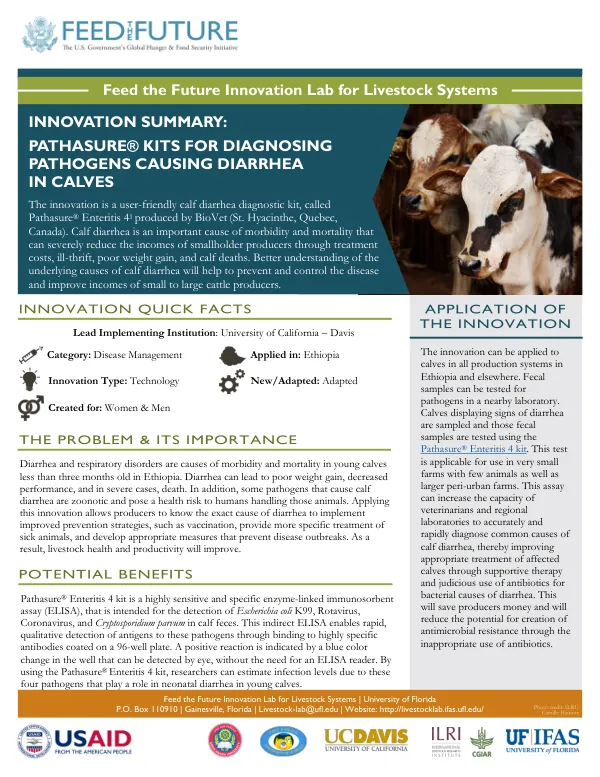
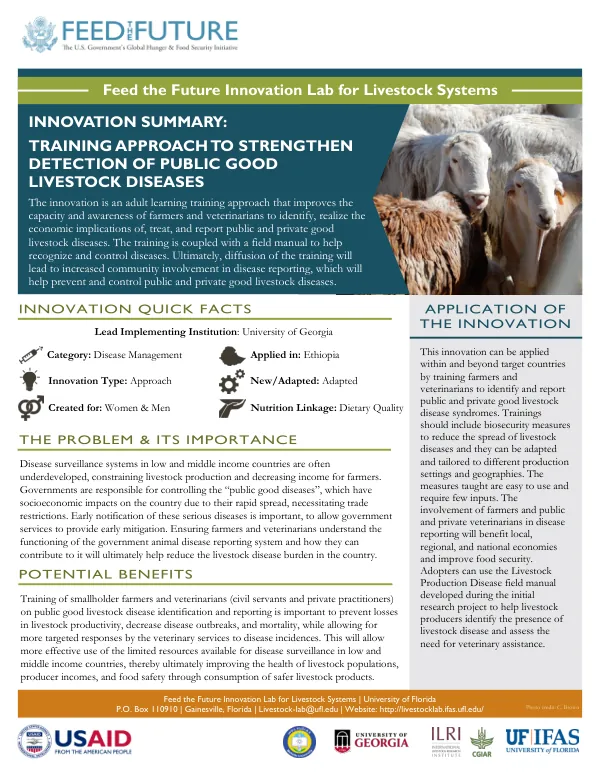
Livestock disease identification and reporting is crucial for preventing losses in livestock productivity, decreasing disease outbreaks, and mortality.
2019 · 1 pages
Sign in to readA free account is required to download.
Abstract
This enables more targeted responses by veterinary services to disease incidences, ultimately improving the health of livestock populations, producer incomes, and food safety through consumption of safer livestock products. Training of smallholder farmers and veterinarians on public good livestock disease identification and reporting is essential for effective use of limited resources available for disease surveillance in low and middle income countries. The training approach focuses on improving the capacity and awareness of farmers and veterinarians to identify, realize the economic implications of, treat, and report public and private good livestock diseases. This is achieved through a combination of adult learning training and a field manual to help recognize and control diseases. The innovation has been adapted and tailored to different production settings and geographies, making it applicable within and beyond target countries. The measures taught are easy to use and require few inputs, allowing for widespread adoption. The involvement of farmers and public and private veterinarians in disease reporting benefits local, regional, and national economies and improves food security. Disease surveillance systems in low and middle income countries are often underdeveloped, constraining livestock production and decreasing income for farmers. Governments are responsible for controlling public good diseases, which have socioeconomic impacts on the country due to their rapid spread, necessitating trade restrictions. Early notification of these serious diseases is essential to allow government services to provide early mitigation. The training approach is designed to strengthen detection of public good livestock diseases, ultimately leading to increased community involvement in disease reporting. This will help prevent and control public and private good livestock diseases, improving the health of livestock populations, producer incomes, and food safety through consumption of safer livestock products. The innovation has been implemented in Ethiopia, with the potential for wider application in other countries.