USAID DEC
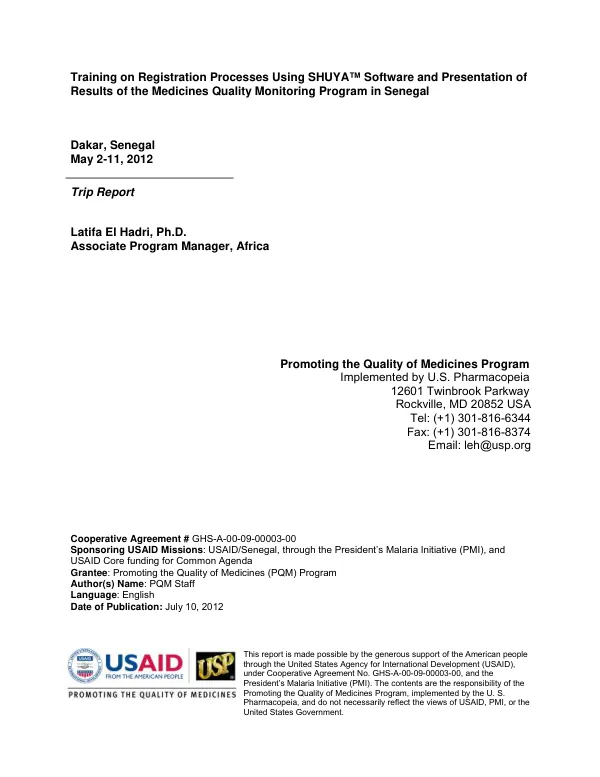
Training on Registration Processes Using SHUYA™ Software and Presentation of Results of the Medicines Quality Monitoring Program in Senegal
Sign inNATIONAL MALARIA CONTROL PROGRAM
Training on Registration Processes Using SHUYA™ Software and Presentation of Results of the Medicines Quality Monitoring Program in Senegal
The Promoting the Quality of Medicines (PQM) program, implemented by the United States Pharmacopeia (USP), is a technical assistance program funded by the U.S.
2012 · 17 pages
Sign in to readA free account is required to download.
Abstract
Agency for International Development (USAID) to strengthen medicine quality assurance systems in developing countries. In Senegal, PQM has been working since 2002 to improve the quality of medicines, with a focus on antimalarials, antiretrovirals, and other essential medicines. To address the challenges faced by the Senegal Department of Pharmacies and Laboratories (DPL) in registering medicines and tracking down failed samples, PQM facilitated a registration training for DPL staff on the use of the SHUYAH™ software. The training, which took place from May 2-11, 2012, aimed to install the electronic registration program software at DPL and train staff on its use. The SHUYAH™ software includes modules to support DPL's management of registration applications, importation, pharmacovigilance, and the exchange of medical and pharmaceutical information. The training focused on the following software modules: registration, importation, pharmacovigilance, and the exchange of medical and pharmaceutical information. During the training, DPL staff learned how to use the software to manage registration applications, grant import licenses, and support adverse drug reaction notifications. The training also covered the exchange of medical and pharmaceutical information, which is essential for ensuring the quality and safety of medicines. In addition to the training, PQM presented the Minilab results for the past two years and planned upcoming medicine quality monitoring activities. The Minilab results showed that the quality of medicines in Senegal has improved over the past two years, with a significant reduction in the number of failed medicines. The PQM program has made significant progress in Senegal, with DPL taking ownership of the medicine quality monitoring program and taking regulatory actions on failed, expired, and unregistered medicines. The program has also expanded to cover additional sentinel sites and has engaged all stakeholders, including the National Malaria Control Program, the University of Cheikh Anta Diop, and the Central Medical Store, in medicines quality control. The PQM program has been successful in improving the quality of medicines in Senegal, and its efforts have been recognized by the Senegalese government and other stakeholders. The program's success is a testament to the importance of investing in medicine quality assurance systems and the need for continued support to ensure the quality and safety of medicines in developing countries. The PQM program has also been recognized for its efforts in promoting the quality of medicines in Senegal. The program has received funding from USAID and has been supported by the President's Malaria Initiative (PMI) and the Core funding for Common Agenda. The program's success has also been recognized by the Senegalese government, which has taken steps to strengthen its medicine quality assurance systems. The PQM program's efforts in Senegal have also been recognized by the international community. The program has been recognized for its efforts in promoting the quality of medicines in developing countries and has been supported by international organizations such as the World Health Organization (WHO) and the United Nations Children's Fund (UNICEF). In conclusion, the PQM program has made significant progress in Senegal, with a focus on improving the quality of medicines and strengthening medicine quality assurance systems. The program's efforts have been recognized by the Senegalese government and the international community, and its success is a testament to the importance of investing in medicine quality assurance systems.