USAID DEC
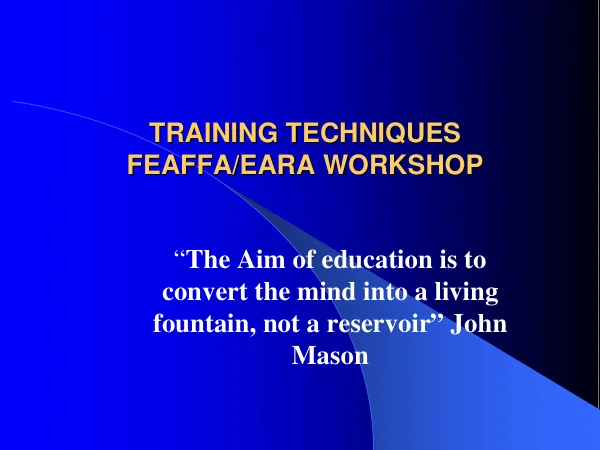
Training Techniques: FEAFFA/EARA Workshop
The FEAFFA/EARA workshop aimed to equip participants with the skills to deliver courses in a professional manner.
63 pages
Sign in to readA free account is required to download.
Abstract
The primary goal of the workshop was to provide participants with a comprehensive understanding of adult learning principles and techniques. Key objectives included understanding and applying knowledge on learning styles, how adults learn, presentation skills, and evaluation and feedback. Adult learners exhibit distinct characteristics, including prior knowledge and experience, self-directed learning, critical thinking, and experiential learning. They also have different learning styles, which can be categorized into four main types: doing, trying, thinking, and watching. Doing involves concrete examples, trying involves active experimentation, thinking involves abstract conceptualization, and watching involves reflective observation. Adult learners require a specific approach to learning, which is centered around their needs and preferences. They need to be involved and consulted, want content to be relevant, enjoy being asked questions, and appreciate feedback on their progress. Additionally, adult learners learn at different rates, may need to unlearn old ideas and habits, and require practical solutions. They also remember concepts better when they are learned recently, heard about multiple times, practiced, and implemented immediately. Motivation plays a crucial role in adult learning, with participants being more likely to engage in learning activities when they perceive a clear benefit or relevance to their job requirements, personal interests, professional enrichment, or advancement potential. By understanding these principles and techniques, participants can design and deliver effective training programs that cater to the unique needs and preferences of adult learners.