USAID DEC
Treatment outcomes of HIV-positive patients on first-line antiretroviral therapy in private versus public HIV clinics in Johannesburg, South Africa
Sign inUNIVERSITY OF WITWATERSRAND
Treatment outcomes of HIV-positive patients on first-line antiretroviral therapy in private versus public HIV clinics in Johannesburg, South Africa
The study aimed to compare treatment outcomes among patients receiving HIV care and treatment at a public and private HIV clinic in Johannesburg, South Africa.
2016 · 11 pages
Sign in to readA free account is required to download.
Abstract
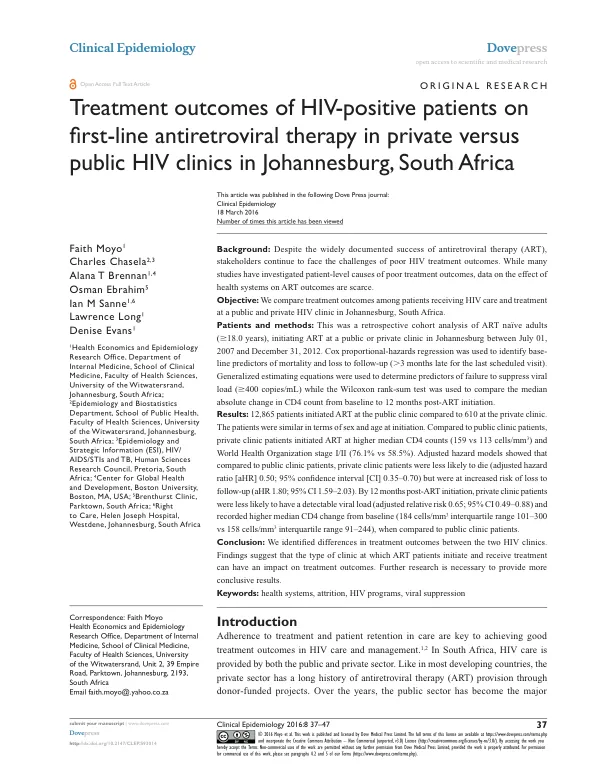
A retrospective cohort analysis of ART naïve adults initiating ART at a public or private clinic between July 01, 2007, and December 31, 2012, was conducted. The study included 12,865 patients from the public clinic and 610 patients from the private clinic. The patients were similar in terms of sex and age at initiation. However, private clinic patients initiated ART at higher median CD4 counts (159 vs 113 cells/mm3) and World Health Organization stage I/II (76.1% vs 58.5%) compared to public clinic patients. Adjusted hazard models showed that private clinic patients were less likely to die (adjusted hazard ratio [aHR] 0.50; 95% confidence interval [CI] 0.35–0.70) but were at increased risk of loss to follow-up (aHR 1.80; 95% CI 1.59–2.03) compared to public clinic patients. By 12 months post-ART initiation, private clinic patients were less likely to have a detectable viral load (adjusted relative risk 0.65; 95% CI 0.49–0.88) and recorded higher median CD4 change from baseline (184 cells/mm3 interquartile range 101–300 vs 158 cells/mm3 interquartile range 91–244) compared to public clinic patients. The study identified differences in treatment outcomes between the two HIV clinics, suggesting that the type of clinic at which ART patients initiate and receive treatment can have an impact on treatment outcomes. The study highlights the challenges faced by both the public and private sectors in achieving desired treatment outcomes. Health system factors, such as clinical mismanagement, poor quality of HIV care, lack of standardization, and poor regulation of services, contribute to poorer treatment outcomes. Attrition is more common in private clinics, while the public sector faces challenges such as overwhelming workloads, reduced counseling sessions, and stigmatization. The study's findings suggest that further research is necessary to provide more conclusive results. The study's results have implications for the development of effective HIV treatment programs and the improvement of treatment outcomes in both the public and private sectors. The study's findings highlight the need for improved health system factors, such as standardization and regulation of services, to achieve better treatment outcomes. The study's methodology involved a retrospective cohort analysis of routinely collected data from a public sector and a private sector HIV clinic. The study included 12,865 patients from the public clinic and 610 patients from the private clinic. The study used Cox proportional-hazards regression to identify baseline predictors of mortality and loss to follow-up, generalized estimating equations to determine predictors of failure to suppress viral load, and the Wilcoxon rank-sum test to compare the median absolute change in CD4 count from baseline to 12 months post-ART initiation. The study's results have implications for the development of effective HIV treatment programs and the improvement of treatment outcomes in both the public and private sectors. The study's findings highlight the need for improved health system factors, such as standardization and regulation of services, to achieve better treatment outcomes.
Related documents
Documents in this collection
 2018
2018USAID DEC
Predictors of switch to and early outcomes on third-line antiretroviral therapy at a large public-sector clinic in Johannesburg, South Africa
Open record 2021
2021USAID DEC