USAID DEC
Tuberculosis throughout History: Breaking News
Tuberculosis has been a persistent public health concern throughout history.
2013 · 1 pages
Sign in to readA free account is required to download.
Abstract
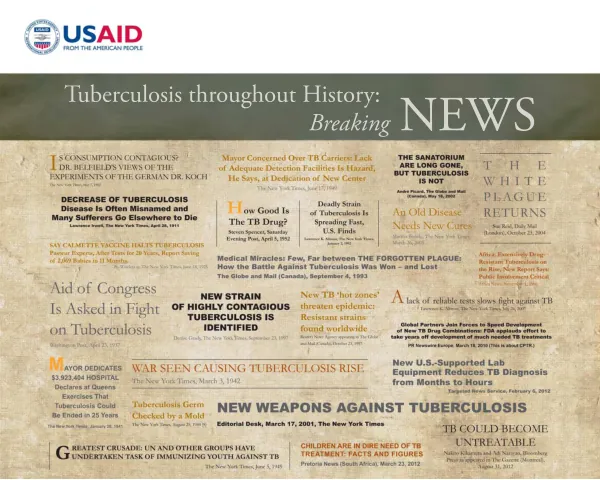
The disease's contagious nature has led to widespread outbreaks, with various strains emerging over time. In the early 20th century, a highly contagious strain of tuberculosis was identified, posing a significant threat to global health. The disease's impact was particularly pronounced in the 1950s, with reports of a deadly strain spreading rapidly. The U.S. government acknowledged the severity of the issue, with officials expressing concern over the lack of adequate detection facilities. This concern was echoed by Mayor John O'Brien, who dedicated a new hospital in 1942, declaring that tuberculosis could be ended in 25 years with concerted effort. Advances in medical technology have played a crucial role in combating tuberculosis. The development of new diagnostic tools, such as lab equipment, has significantly reduced the time required for diagnosis, from months to hours. Additionally, researchers have explored the use of mold to check the tuberculosis germ, highlighting the ongoing quest for effective treatments. The fight against tuberculosis has also involved international cooperation, with organizations such as the United Nations undertaking initiatives to immunize youth against the disease. In South Africa, the need for tuberculosis treatment among children was highlighted, with reports emphasizing the dire situation and the importance of addressing it. However, concerns remain about the emergence of resistant strains, which threaten to undermine progress in the fight against tuberculosis. A lack of reliable tests has slowed efforts to combat the disease, underscoring the need for continued research and development of new diagnostic tools and treatments. The development of a new tuberculosis drug combination has been identified as a priority, with the goal of speeding up the development process. In recent years, the global health community has come together to address the tuberculosis epidemic, with a focus on identifying and addressing the root causes of the disease. The use of new technologies, such as molecular diagnostics, has improved the accuracy and speed of diagnosis, while also enabling the detection of drug-resistant strains. Despite these advances, the battle against tuberculosis remains ongoing, with continued efforts required to prevent the spread of the disease and ensure that those affected receive timely and effective treatment.