GOVERNMENT OF KENYA
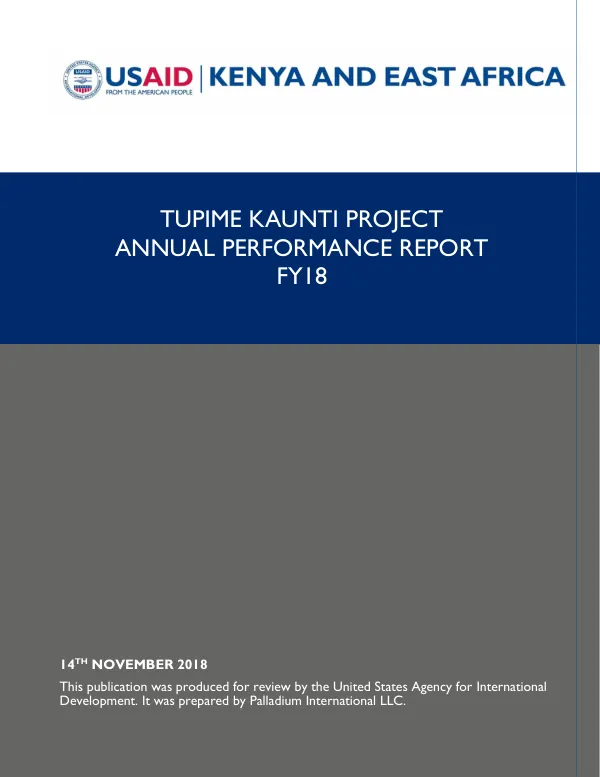
Tupime Kaunti Project FY18 Performance Report
The Tupime Kaunti project is a USAID-funded initiative operating in eight counties of Kenya, including Kisumu, Migori, Kakamega, Busia, Bungoma, Vihiga, Kisii, and Homa Bay.
2018 · 40 pages
Sign in to readA free account is required to download.
Abstract
The project's primary objectives are to enhance leadership and management capacity of county governments for effective outcome measurements, learning, and accountability systems, and to increase the availability, analysis, and use of high-quality data for decision-making. Key achievements under the first sub-purpose include strengthened leadership structures at the county level, which have led to increased resource allocation for county departments of health. For instance, in Busia, the project initiated a Leadership Development Group (LDG) that held a high-level advocacy meeting with the county Governor, resulting in an increased budgetary allocation to health from Kshs 1.59 billion to Kshs 2 billion. Similarly, the budget for the Bungoma county department of health increased from Kshs 2.6 billion to Kshs 2.8 billion. The project's technical and financial support also led to the revitalization of Malaria Technical Working Groups (TWGs) in some counties, including Siaya, Kisumu, Kakamega, and Vihiga. The project's support resulted in the appointment of M&E officers for Vihiga, Kisumu, and Busia counties and the revitalization of Reproductive, Maternal, Newborn, Child, and Adolescent Health (RMNCAH) TWGs in Migori, Kakamega, Kisii, and Busia counties. The project accelerated counties taking leadership in initiating the development of key county strategic documents, including end-term reports, the County Health Sector Strategic and Investment Plan (CHSSIP) 2018-2023, and annual capacity-building plans. There was evidence of strengthened leadership and management capacities in the focus counties, with the Kisii county LDG Group transitioning to the Ministerial Leadership Coordination Committee, a legally recognized county governance structure. A participatory project pulse assessment survey showed that there was increased capacity in measurement, learning, and accountability systems among counties, from a score of 46.9% at baseline in FY17 to 58.4% by the end of FY18. The project also strengthened policy capacities across counties, with county ownership in policy formulation and monitoring evident. The LDG groups steered the development of the health chapter of the County Integrated Development Plan (CIDP) 2018-2023 and the draft CHSSIP 2018-2023. Under the second sub-purpose, all counties were able to develop program-based budgets (PBB) for the first time. Importantly, all counties developed work plans and budgets that were aligned to the Medium-Term Expenditure Framework (MTEF) cycle. Migori, Vihiga, and Kakamega counties used priorities from the CHSSIP 1 End Term Reviews (ETRs) to develop Sector Working Group (SWG) reports for FY2018/19 to 2020/21. Counties also drew priorities and targets from various strategic documents, such as CHSSIP ETRs and Annual Progress Reports (APRs), during the development of Annual Work Plans (AWPs) and drafting of CHSSIP 2018/23. The project's efforts have led to increased stakeholder participation and ownership in the development of the CHSSIP 2018-2023, Annual Work Plan for FY 2018/2019, and M&E-related activities across all focus counties. The county core leadership played a critical role in aligning county priorities to health outcomes, with a sensitization on outcomes measurement during the LDG group re-orientation in Homa-Bay, Kisii, and Migori counties. Migori county reviewed the performance contract of the Chief Officer for Health (CECM) to reflect realistic and evidence-based targets for indicators, and all three counties demonstrated an emphasis on outcomes measurement and reviewed their respective draft strategic plans to ensure that all health outcomes indicators are explicitly captured with realistic targets.