PALLADIUM INTERNATIONAL, LLC
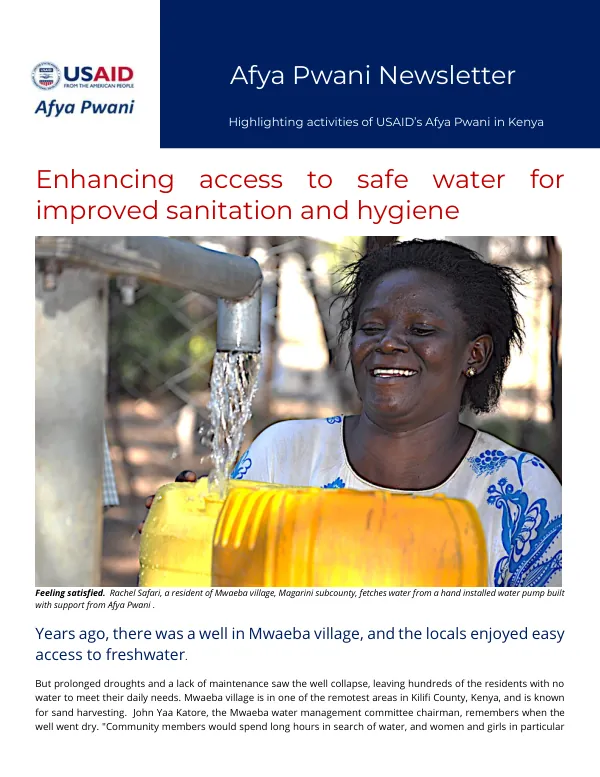
USAID Afya Pwani Project: Improving Hygiene and Sanitation in Kilifi County
The USAID Afya Pwani Project aimed to improve and increase access to quality health services in Kenya through strengthened service delivery and institutional capacity of county health systems.
2021 · 5 pages
Sign in to readA free account is required to download.
Abstract
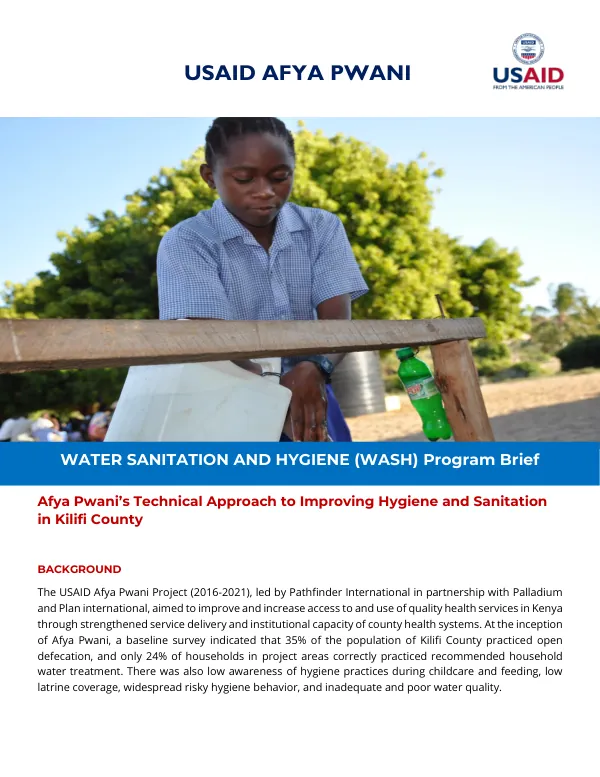
The project, led by Pathfinder International in partnership with Palladium and Plan International, was implemented in Kilifi County from 2016 to 2021. At the inception of Afya Pwani, a baseline survey indicated that 35% of the population practiced open defecation, and only 24% of households in project areas correctly practiced recommended household water treatment. To reduce childhood illness in Kilifi County, Afya Pwani supported the improvement of hygiene and sanitation at health facilities, communities, and schools. The program employed six main strategies to achieve its goal, including increasing access to safe water, improving sanitation in communities and schools, school-led total sanitation, sanitation scale-up, capacity strengthening, and hygiene promotion. The project rehabilitated and installed roof catchment systems for rainwater harvesting, water pipeline extension, and connections to schools and community health care facilities. Additionally, the project procured and distributed water treatment chemicals and supported the construction of ventilated Improved Pit (VIP) latrines in health care facilities. Afya Pwani also supported the training of community resources persons (CORPs) on governance, leadership, management, financial mobilization, group dynamics, conflict resolutions, hygiene promotion, community-led total sanitation (CLTS), operation, and maintenance. The CORPs trained are artisans, community health volunteers (CHVs), hygiene champions, community-based CLTS promoters, water-management committees (WMCs), health facility management committees (HFMCs), and school board of management (SBOM). The trained CORPs sensitized and mobilized the communities who participated in the WASH activity implementation using locally available resources. The project achieved significant results, including a 5% decrease in the number of people practicing open defecation, a 24% increase in the number of households correctly using water treatment technologies, and the training of 452 CORPs. Additionally, a total of 29,037 people within the project areas have access to safe water and 26,061 have access to improved sanitation services due to USAID Afya Pwani project support. Twenty villages were certified open defecation free (ODF) by national certifiers and 25 villages certified ODF by county third-party certifiers in the target areas. The project also supported the establishment of five self-help groups for project sustainability beyond the life of the project. The lessons learned from the project include the importance of local leaders' involvement in community health project implementation, the scale-up of sanitation marketing using locally available technology and resources, and the enhanced engagement of trained community resources persons on mobilization and use of locally available resources. The recommendations from the project include the integration and institutionalization of the Community-led total sanitation (CLTS) approach in maternal, newborn, child health, family planning, and nutrition, the use of locally available resources and technologies to accelerate community sanitation and hygiene scale-up and sustainability, and the development of a county-based CLTS approach by the Kilifi county health department.