USAID DEC
Turning the Wheels Towards Economic Prosperity Through Investment in Family Planning
Sign inGHANA HEALTH SERVICE
Turning the Wheels Towards Economic Prosperity Through Investment in Family Planning
Ghana's population remains young, with a significant proportion of the population under the age of 15.
2021 · 2 pages
Sign in to readA free account is required to download.
Abstract
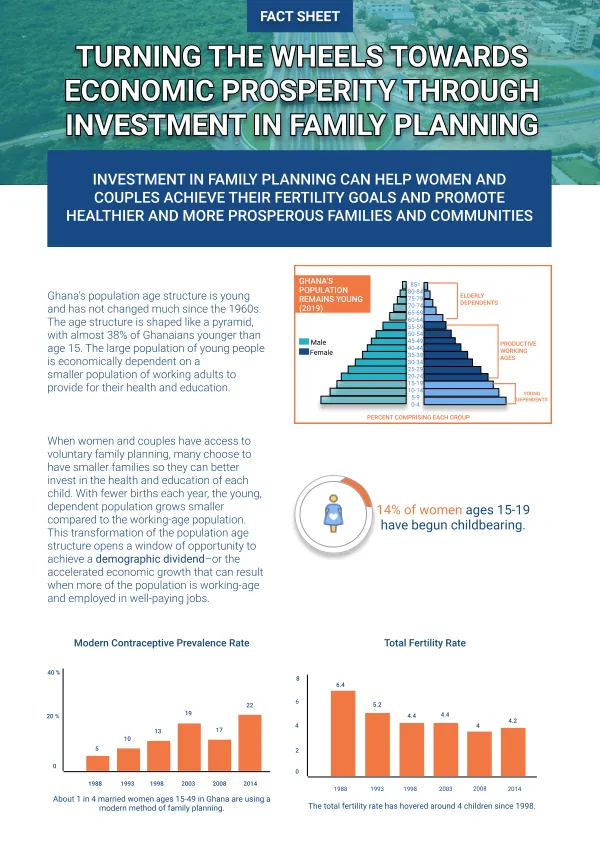
As of 2019, approximately 38% of Ghanaians are younger than 15, while the working-age population is smaller and economically dependent on the younger population to provide for their health and education. This age structure is shaped like a pyramid, with a large base of young dependents and a smaller population of working adults. The large population of young people is a result of high fertility rates, with the total fertility rate hovering around 4 children since 1998. However, modern contraceptive prevalence rates have improved, with about 1 in 4 married women ages 15-49 in Ghana using a modern method of family planning. Despite this progress, 14% of women ages 15-19 have begun childbearing, indicating a need for further investment in family planning. Investing in family planning can help women and couples achieve their fertility goals and promote healthier and more prosperous families and communities. By choosing to have smaller families, women can better invest in the health and education of each child, leading to a transformation of the population age structure. This transformation opens a window of opportunity to achieve a demographic dividend, or the accelerated economic growth that can result when more of the population is working-age and employed in well-paying jobs. To achieve a demographic dividend, Ghana must invest in human capital, including education and healthcare. The government can increase procurement of contraceptive methods, expand access to a wider range of contraceptive methods for young people, and create budget lines for family planning care using district assemblies' common funds. Additionally, investing in quality education infrastructure, modernizing farming practices, and promoting agro-processing can help to create a productive Ghana for future generations.