GHANA HEALTH SERVICE
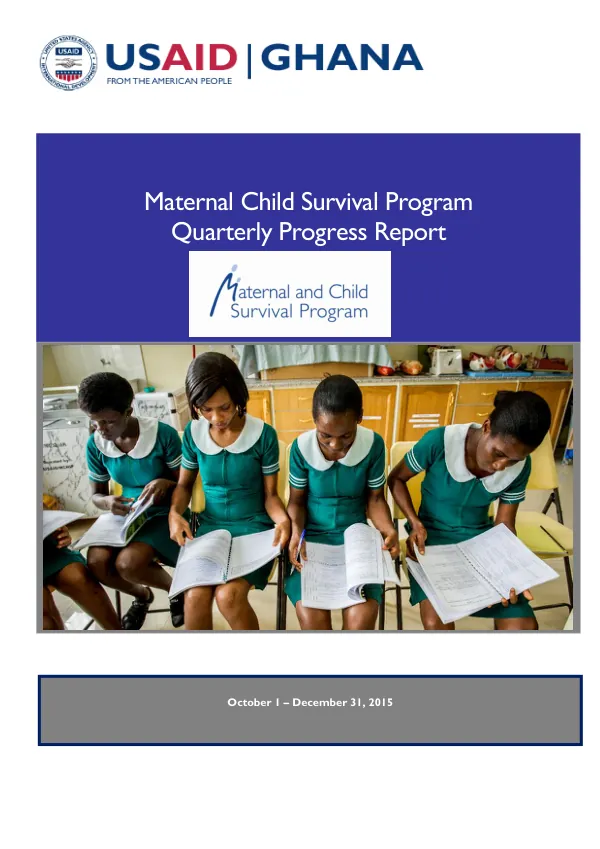
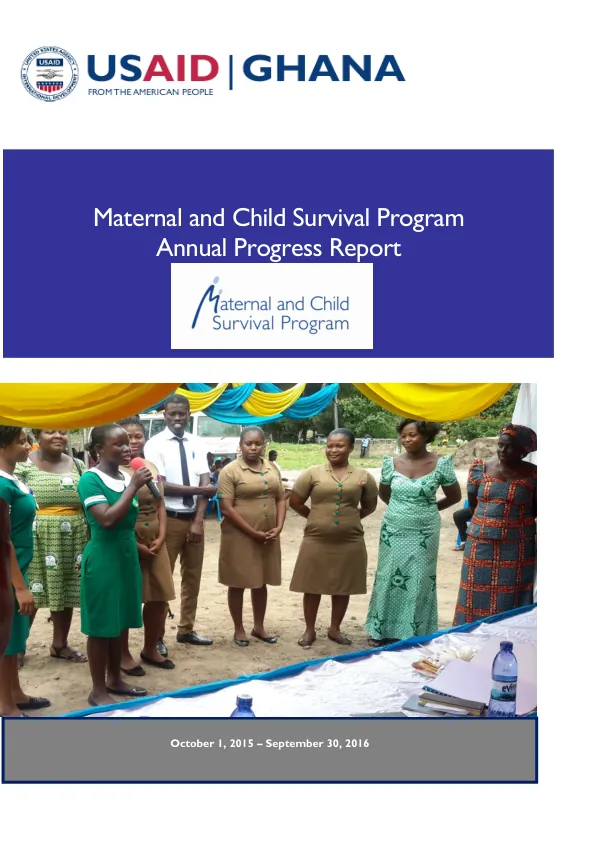
Maternal and Child Survival Program Annual Progress Report FY 2016
The Maternal and Child Survival Program (MCSP) is a project aimed at improving health outcomes for HIV, malaria, nutrition, family planning, and maternal, newborn, and child health services in Ghana.
2016 · 56 pages
Sign in to readA free account is required to download.
Abstract
The project is implemented in collaboration with the Ministry of Health (MOH), the Ghana Health Service (GHS), and other USAID-funded partners. During the second year of the project (October 1, 2015 – September 30, 2016), MCSP achieved several outputs under each objective. Objective 1 focused on developing a better-prepared midwifery and nursing workforce equipped to provide HIV, malaria, nutrition, family planning, and maternal, newborn, and child health services. MCSP adapted and tested the Android-based malaria game, Hello Nurse!, onto a web platform, completed the evaluation of various learning management systems, and chose to adopt and adapt Moodle LMS and Moodle mobile application. MCSP also developed storyboards by training subject-matter tutors from the Nursing and Midwifery Training College (NMTC) in Mampong-Ashanti to understand the process of creating eLearning objects. The eLearning modules and learning objects developed included topics such as gender-based violence, kangaroo mother care, PMTCT, use of partograph, cord care, complementary feeding, exclusive breastfeeding, community management of acute nutrition, bimanual and aortic compression, suturing skills, and WASH-diarrhea. In addition, MCSP uploaded family planning (FP) modules developed by the American College of Nursing and Midwifery (ACNM) to the MOH modules portal for IT tutors to download and distribute to students and tutors. MCSP also strengthened preceptorship at six midwifery schools by supporting them to complete all the activities outlined in their fixed amount award (FAA) implementation plans. Objective 2 focused on standardizing and approving the national Community-based Health Planning Service (CHPS) strategy, guidelines, training materials, tools, and monitoring systems. MCSP drafted the national CHPS implementation guidelines in collaboration with PPME and other CHPS implementing partners. A national CHPS forum was held on September 30, 2016, where the Minister of Health launched the national CHPS implementation guidelines and CHPS web page as part of the GHS website. Objective 3 aimed to strengthen management and support systems in USAID/MCSP-supported regions and districts to implement CHPS according to updated and harmonized policy and guidelines. MCSP assisted the regions to complete their annual integrated plans and conducted RMNCH scorecard refresher trainings and supportive supervision visits to Brong Ahafo and Ashanti regions. In addition to the above objectives, MCSP implemented an infection prevention control (IPC) workplan funded by the Global Health Ebola Team (GHET). The activities achieved to date included training 151 trainers in IPC for the five regions. Project administration changes occurred during the reporting period, with Karen Caldwell assuming duty as Country Director and COP for MCSP in July 2016. The subsequent quarter's work plan focused on pre-service education, with major activities including conducting RMNCH scorecard refresher trainings and supportive supervision visits to the five regions. The project's progress was monitored and evaluated through various indicators, including the number of trainers trained in IPC, the number of midwifery and community health nursing schools equipped with skills labs, and the number of CHPS compounds upgraded and launched. The project's achievements were presented at the national CHPS forum, and the results of the IPC workplan were incorporated into the report.
Related documents