USAID DEC
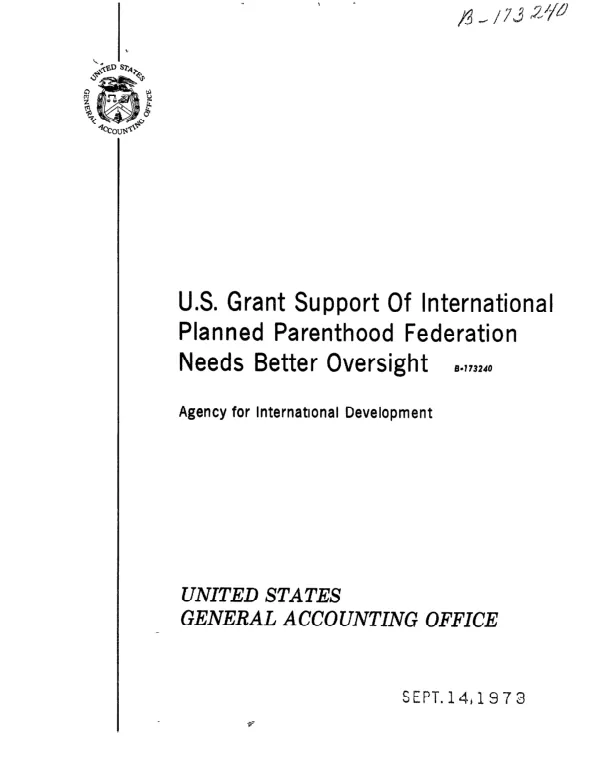
U.S. Grant Support of International Planned Parenthood Federation Needs Better Oversight
Sign inUSAID
U.S. Grant Support of International Planned Parenthood Federation Needs Better Oversight
The Agency for International Development (AID) provides approximately $10 million annually as grant budgetary support for private family planning activities carried out by the International Planned Parenthood Federation (IPPF).
36 pages
Sign in to readA free account is required to download.
Abstract
The General Accounting Office (GAO) reviewed the system of management controls surrounding the grant because IPPF was one of the largest recipients of AID grants for population growth control activities. AID does not participate in IPPF's programming, nor does it audit activities of IPPF's family planning associations. Instead, AID evaluates performance on the basis of annual reports, audits at IPPF's central office in London, and other internal AID information. Grant management relationships changed in April 1971 from specific IPPF projects, reviewed and approved by AID, to general budgetary support of IPPF's overall program. IPPF resisted any grant provisions that were too burdensome or which infringed on its independence. IPPF's income has grown substantially, from about $900,000 in 1965 to over $19 million in 1971. Rapid growth has contributed to a number of organizational and operational problems. AID's limited grant review and monitoring and its strong reliance on the management control system of IPPF's central office in London provides minimal control upon the use of funds. Affecting this arrangement are AID's view on the competency of IPPF and AID's acceptance of IPPF's view that effective rapport with less developed countries depends upon full IPPF autonomy. At IPPF's central office, GAO noted several problems bearing on IPPF's ability to implement effective programs and to reasonably assure donors of program effectiveness. Management review and control over family planning activities by family planning associations is uneven and weak. IPPF is making improvements in personnel practices, programming, auditing, and reporting. The Secretary General has indicated that management reforms will take several years. GAO perceives the grant arrangement as a realistic attempt to insure effective use of U.S. population assistance funds and to enlarge the scope of the program. IPPF is qualified to sponsor the inception and improvement of indigenous family planning programs and is of value to AID in carrying out its congressional mandate on population assistance. GAO noted that officials of both AID and IPPF were keenly aware of the need for adequate accountability controls when public programs and funding were entrusted to a private, decentralized organization. Nevertheless, shortcomings in IPPF's capability to direct and monitor programs convinced GAO that AID and IPPF needed to provide greater assurance that purposes of the AID grant were being achieved in an efficient and economical manner. IPPF's annual "Report to Donors" and audits at its central office could be improved to enhance AID's management process. GAO recommends that the Administrator, AID, provide increased assistance and advice to the IPPF central and regional offices, as necessary, for working out a specific, phased plan for timely submission of accurate and reliable reports and data from national associations, more field reviews, inspections, and reports by IPPF central and regional offices, improvements in the extent and quality of independent audits of associations' programs and management, and more effective evaluation and reporting by IPPF's central office to AID. GAO also recommends that the Administrator, AID, improve the review and evaluation of IPPF operations by making a more complete review of IPPF's management system to provide greater assurance that grant objectives are being met.
Related documents