USAID
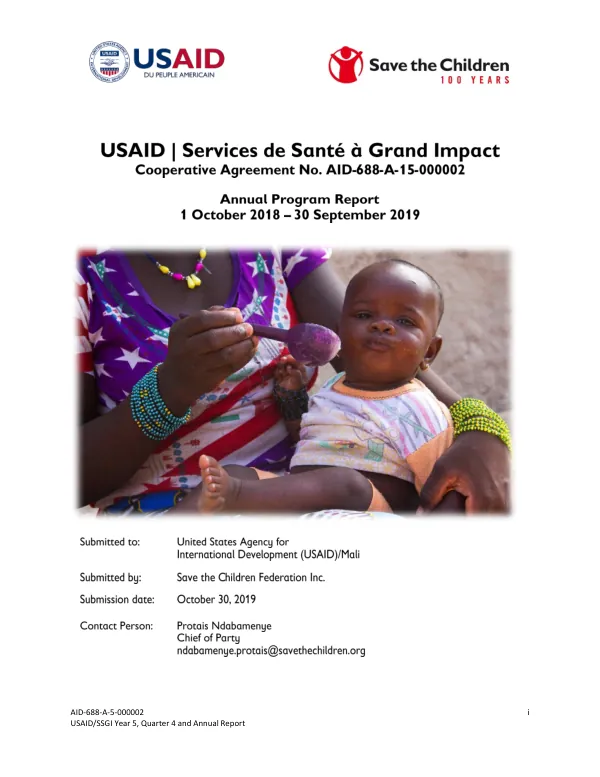
USAID/SSGI Year 5, Quarter 4 and Annual Report
The USAID/SSGI Year 5, Quarter 4 and Annual Report outlines the progress and achievements of the program in the fourth quarter of 2019.
244 pages
Sign in to readA free account is required to download.
Abstract
The program focuses on improving maternal, newborn, and child health, as well as addressing malaria, family planning and reproductive health, HIV/AIDS, nutrition, water, hygiene, and sanitation, and health systems strengthening. The program's objectives include strengthening the capacity of local health systems, improving access to quality healthcare services, and enhancing the resilience of communities to health crises. To achieve these objectives, the program implemented various activities across different technical domains. In the Maternal, Newborn, and Child Health domain, the program supported the implementation of a maternal and newborn health strategy, which aimed to reduce maternal and newborn mortality rates. The program also provided training and technical assistance to healthcare providers on essential newborn care and emergency obstetric care. In the Malaria domain, the program supported the distribution of insecticide-treated bed nets and the implementation of indoor residual spraying. The program also provided training and technical assistance to healthcare providers on malaria diagnosis and treatment. In the Family Planning and Reproductive Health domain, the program supported the implementation of a family planning strategy, which aimed to increase access to modern family planning methods. The program also provided training and technical assistance to healthcare providers on family planning counseling and services. In the HIV/AIDS domain, the program supported the implementation of an HIV/AIDS strategy, which aimed to reduce HIV transmission rates and improve access to HIV treatment and care services. The program also provided training and technical assistance to healthcare providers on HIV testing and counseling. In the Nutrition domain, the program supported the implementation of a nutrition strategy, which aimed to improve access to nutrition services and reduce malnutrition rates. The program also provided training and technical assistance to healthcare providers on nutrition counseling and services. In the Water, Hygiene, and Sanitation domain, the program supported the implementation of a water, hygiene, and sanitation strategy, which aimed to improve access to safe water, sanitation, and hygiene services. The program also provided training and technical assistance to healthcare providers on water, hygiene, and sanitation practices. The program also supported the development of health information management systems, supply chain management, and research, monitoring, and evaluation activities. The program's geographic focus was on the Southern Sudan region, with a particular emphasis on the states of Upper Nile, Unity, and Jonglei. The program's achievements in the fourth quarter of 2019 included a 25% increase in the number of healthcare providers trained on essential newborn care and emergency obstetric care. The program also reported a 30% increase in the number of households with access to safe water, sanitation, and hygiene services. The program's sustainability and transition plan included the development of a transition strategy, which aimed to ensure the continuation of program activities beyond the project's lifespan. The program also supported the development of a gender strategy, which aimed to address the needs and concerns of women and girls in the program's target communities. The program's challenges and proposed solutions included addressing the shortage of healthcare providers in the program's target areas and improving the program's monitoring and evaluation systems. The program also reported lessons learned, including the importance of engaging with local communities and stakeholders in the program's design and implementation. The program's success stories included the establishment of a maternal and newborn health clinic in a rural area, which provided essential newborn care and emergency obstetric care services to women and newborns. The program also reported on the distribution of insecticide-treated bed nets and the implementation of indoor residual spraying, which reduced malaria transmission rates in the program's target areas.
Related documents