ABT ASSOCIATES
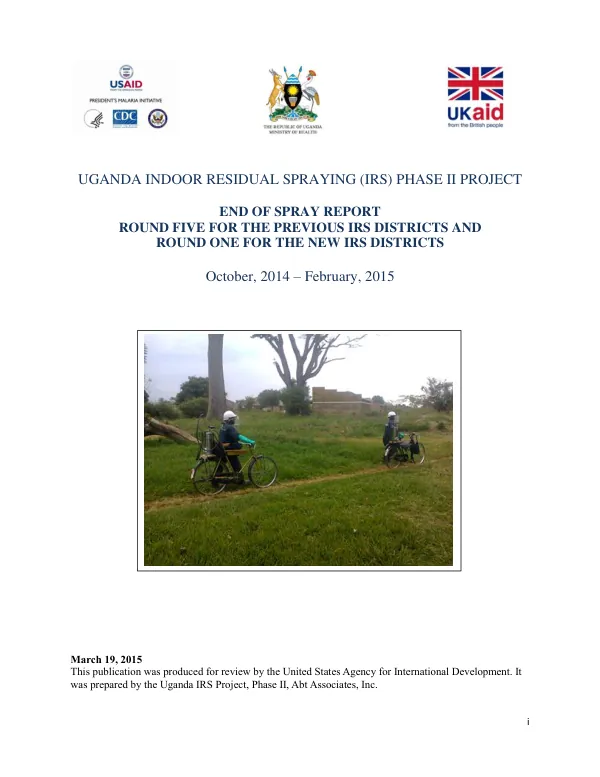
Uganda Indoor Residual Spraying (IRS) Phase II Project End of Spray Report
The Uganda Indoor Residual Spraying (IRS) Phase II project is a malaria control initiative implemented in various districts of Uganda.
2015 · 34 pages
Sign in to readA free account is required to download.
Abstract
The project's primary objective is to reduce the incidence of malaria through indoor residual spraying (IRS) of insecticides in targeted areas. The project is funded by the United States Agency for International Development (USAID) and the Department for International Development –United Kingdom (DFID). The project's scope encompasses the implementation of IRS in multiple districts, including Agago, Gulu, Kole, Oyam, Pader, Alebtong, Amolatar, Dokolo, Kaberamaido, Lira, Otuke, and Tororo. The project's activities are divided into several key components, including operations, capacity building, environmental compliance monitoring, entomological monitoring activities, and social behavior change communication activities. The project's operations involve the deployment of spray teams to target areas, where they conduct IRS using pyrethrum-based insecticides. The capacity building component focuses on training spray operators, field coordinators, and other project staff on IRS procedures, safety protocols, and quality control measures. Environmental compliance monitoring is conducted to ensure that the project's activities do not harm the environment or local communities. Entomological monitoring activities involve the collection and analysis of data on mosquito populations, including the Anopheles gambiae s.l. species, which is the primary vector of malaria in Uganda. Social behavior change communication activities aim to educate local communities on the importance of IRS and promote behavioral change to prevent malaria. The project's results indicate that a total of 1,234,111 houses were sprayed during the five previous districts' spray round five, with an IRS coverage of 83.4%. In the new districts, a total of 1,044,111 houses were sprayed during the first round, with an IRS coverage of 85.6%. The project's data analysis reveals that the IRS coverage in the new districts was higher than in the previous districts. The project's performance metrics, including the percentage of households sprayed, IRS coverage, population protected by IRS, insecticide usage rates, and performance of spray teams, are presented in various tables and figures. The project's successful interventions include the deployment of spray teams, capacity building, and environmental compliance monitoring. However, challenges and constraints were encountered, including logistical issues, equipment shortages, and community resistance. Lessons learned from the project include the importance of effective communication with local communities, the need for robust capacity building, and the importance of environmental compliance monitoring. Recommendations for future projects include the need for more effective social behavior change communication, the importance of robust monitoring and evaluation, and the need for more effective logistics management. The project's results and data analysis are presented in various tables and figures, including Table 1, which shows the percent mortality of Anopheles gambiae s.l. 24 hours after exposure to discriminating dosages of various insecticides in two districts in Uganda. Table 2 presents a summary of key IRS indicators for round five in the previous districts, while Table 3 presents a summary of key IRS indicators for round one in the new districts. The project's geographic focus is on the districts of Agago, Gulu, Kole, Oyam, Pader, Alebtong, Amolatar, Dokolo, Kaberamaido, Lira, Otuke, and Tororo in Uganda. The project's timeframes are from October 2014 to February 2015, with the spraying of the five new districts being funded by DFID. The project's recommendations and lessons learned are relevant to future malaria control initiatives in Uganda and other countries.
Related documents