USAID DEC
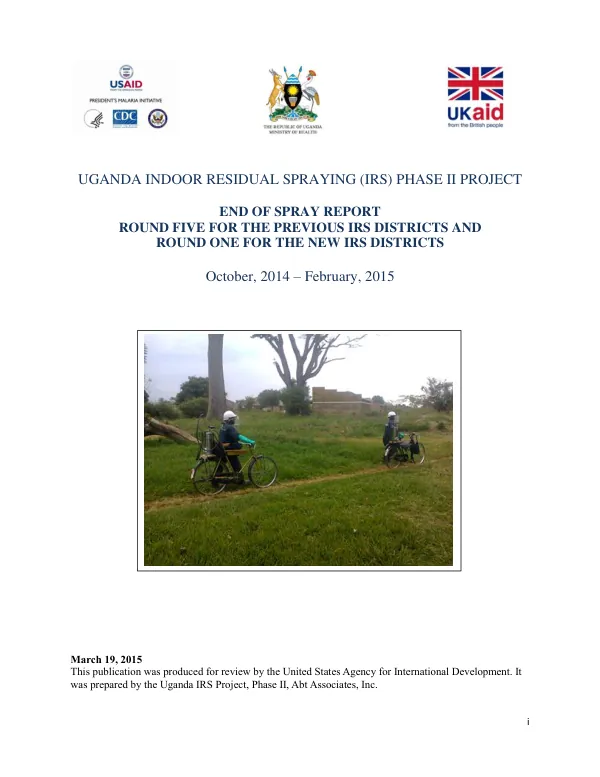
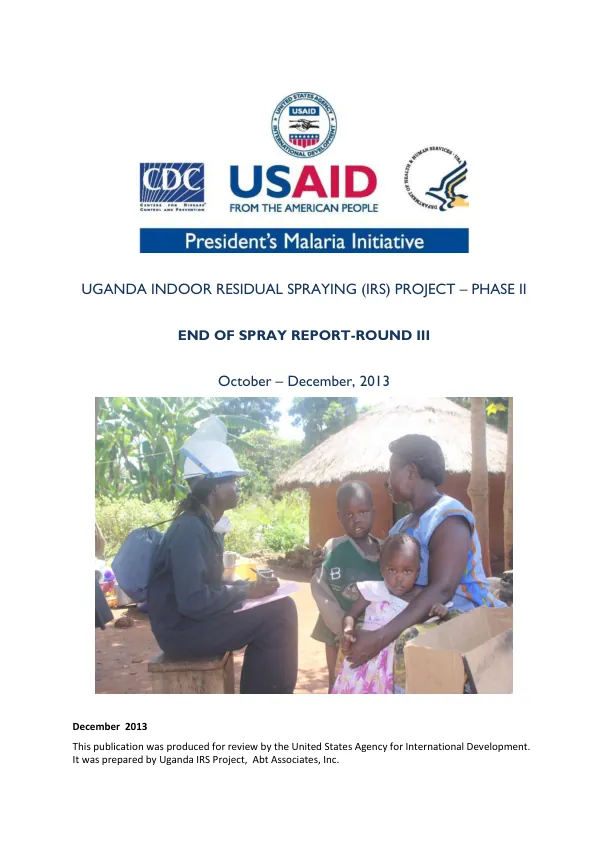
Uganda Indoor Residual Spraying (IRS) Project – Phase II: End of Spray Report Round 3, October – December, 2013
Sign inABT ASSOCIATES
Uganda Indoor Residual Spraying (IRS) Project – Phase II: End of Spray Report Round 3, October – December, 2013
The Uganda Indoor Residual Spraying (IRS) Project Phase II is a continuation of the achievements of Phase I, which was implemented from July 2009 – June 2012.
2013 · 23 pages
Sign in to readA free account is required to download.
Abstract
The project aims to achieve the President's Malaria Initiative (PMI) Uganda targets for IRS. The overall objective of the project is to reduce malaria-related mortality by 70 percent by the end of 2015 in Uganda. The project implemented several activities in preparation for spray round 3, including micro-planning meetings, stores and soak pit assessment and renovation/repairs, logistics distribution, spray teams recruitment and orientation, and health and safety measures. A total of 3,173 spray operators (SOs) participated in round 3, of whom 813 (25 percent) were new entrants and 655 (20 percent) of the total recruited SOs were women. Spraying in group A districts commenced on October 14, 2013, and ended by November 21, 2013. Spraying in group B districts started on November 4, 2013, and was completed by December 7, 2013. During spraying, the project team adhered to IRS-related environmental compliance guidelines. The overall IRS coverage was 92.7 percent, and all districts attained the target coverage of 90 percent with the exception of Kitgum. The average number of houses sprayed per SO was 12, and the average insecticide usage rate was 2.6 households per sachet. The project introduced several innovations during this spray round, including stronger collaboration between Local Council One (LC1) chairpersons and SOs during SO training, use of the supervision checklist by all supervisors, addition of monitoring and evaluation (M&E) questions to the dashboard data collection tool, and the use of hired motorcycles (boda bodas) to transport SOs to hard-to-reach areas. The project continued to face the ongoing challenge of insecticide pilferage and abuse, and took effective and timely remedial actions, including tracking down the culprits and ensuring that the guilty individuals were prosecuted. The heavy rains, especially during logistics distribution and at the beginning of spraying in group A districts, slowed down distribution and spraying. The harvest season in some districts, particularly in Kitgum and Lamwo, also interfered with spraying, as it led to some households shifting to farmlands far away from their usual residences, and hence were unavailable when the SOs came for spraying their houses. The project's success in achieving high IRS coverage and reducing malaria-related mortality is attributed to the effective collaboration between the project team, Local Council One (LC1) chairpersons, and spray operators. The project's continued efforts to address the challenges of insecticide pilferage and abuse, and to improve logistics distribution and spraying efficiency, are crucial to achieving the PMI Uganda targets for IRS. The project's achievements in spray round 3 demonstrate its commitment to reducing malaria-related mortality in Uganda. The project's continued success will depend on its ability to address the ongoing challenges and to improve its logistics and spraying efficiency. The project's innovations, such as the use of hired motorcycles and the supervision checklist, have shown promise in improving the project's effectiveness and efficiency. The project's success in achieving high IRS coverage and reducing malaria-related mortality has significant implications for the health and well-being of the people of Uganda. The project's continued efforts to address the challenges of insecticide pilferage and abuse, and to improve logistics distribution and spraying efficiency, are crucial to achieving the PMI Uganda targets for IRS and to reducing malaria-related mortality in Uganda.