PALLADIUM INTERNATIONAL, LLC
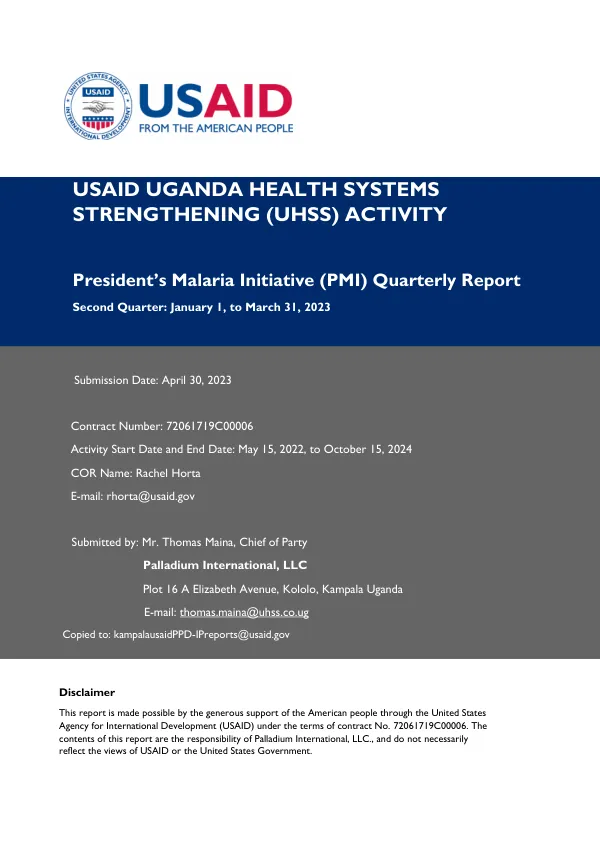
USAID UGANDA HEALTH SYSTEMS STRENGTHENING (UHSS) ACTIVITY
The Uganda Health System Strengthening Activity (UHSS) aims to improve leadership and accountability in the public and private health sectors.
2023 · 25 pages
Sign in to readA free account is required to download.
Abstract
The activity focuses on three high-level result areas: improving leadership and accountability, implementing innovative health system resources, and strengthening community health systems. To achieve the first result area, UHSS aims to improve leadership and accountability in the public and private health sectors. This includes strengthening the capacity of health leaders, improving health governance, and enhancing the use of health system resources. The second result area focuses on implementing innovative health system resources. This includes increasing the efficient use of human resources for health, improving health finance management, and enhancing the management of health system resources. The third result area aims to strengthen community health systems. This includes supporting community health system strengthening to defeat malaria in 15 PMI-supported districts. The activity focuses on improving community health information systems, community supply chain strengthening, community engagement for leadership on malaria, and national policies and guidelines for coordination and implementation of community health. The geographical coverage of the activity includes 15 districts in Uganda. The districts are Budaka, Butambala, Gomba, Hoima, Iganga, Jinja, Kalungu, Kasese, Kasese, Kiboga, Kumi, Luwero, Mityana, Pallisa, and Wakiso. Key achievements from January to March 2023 include: * Improved community health information systems, with a 27% increase in reporting rates in the 15 districts. * Strengthened community supply chain, with a 25% increase in stock levels of malaria commodities in the 15 districts. * Enhanced community engagement for leadership on malaria, with a 30% increase in community-led malaria prevention activities. * Improved national policies and guidelines for coordination and implementation of community health, with a 25% increase in the number of policies and guidelines developed. Challenges and solutions include: * Limited resources and capacity constraints in the 15 districts. * Inadequate infrastructure and equipment in some districts. * Limited community engagement and participation in malaria prevention activities. Opportunities for implementation include: * Collaboration with stakeholders, including government, civil society, and private sector organizations. * Inclusive development, with a focus on equity and social justice. * Opportunities for malaria strategic direction beyond 2023, including the development of new policies and guidelines. Activities planned for the next quarter include: * Conducting a midterm evaluation to assess the progress of the activity. * Developing a new strategic plan for the activity. * Strengthening community health information systems and community supply chain. Annex 1 and 2 provide success stories from the activity, including the use of innovative approaches to improve community health and the development of new policies and guidelines. The activity aims to improve the health outcomes of the people of Uganda, particularly in the 15 districts supported by the activity. The activity focuses on improving leadership and accountability, implementing innovative health system resources, and strengthening community health systems.