USAID DEC
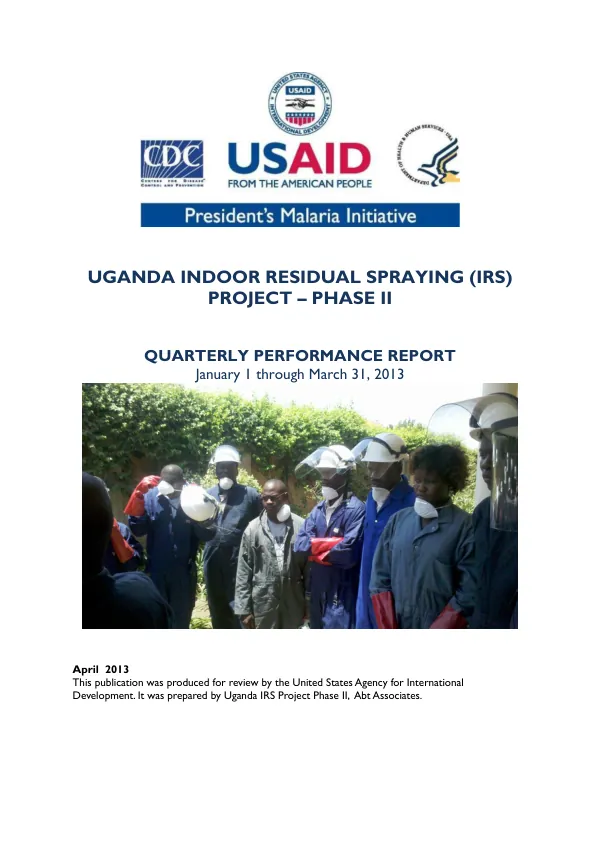
Uganda Indoor Residual Spraying (IRS) Project – Phase II Quarterly Performance Report: January 1 through March 31, 2013
Sign inABT ASSOCIATES
Uganda Indoor Residual Spraying (IRS) Project – Phase II Quarterly Performance Report: January 1 through March 31, 2013
The Uganda Indoor Residual Spraying (IRS) Project Phase II is a quarterly performance report covering the period from January 1 to March 31, 2013.
2013 · 23 pages
Sign in to readA free account is required to download.
Abstract
The project aims to implement a high-quality, safe, and effective IRS program in Uganda. The project is implemented by Abt Associates, Inc. and is funded by the United States Agency for International Development (USAID). The project has three main results: Result 1, which focuses on implementing a high-quality, safe, and effective IRS program; Result 2, which involves capacity building and innovative approaches in IRS; and Result 3, which encompasses comprehensive monitoring and evaluation of the IRS program. The project activities are implemented in 10 districts in Northern Uganda, with a focus on Acholi and Lango sub-regions. In terms of Result 1, the project implemented various activities, including micro-planning meetings, stores and soak-pits assessments and repairs, pump calibration and servicing, and spray team recruitment. The project also trained new spray operators and wash persons in IRS, and oriented sub-county IRS committees on social mobilization for IRS. Additionally, the project conducted radio talk-shows and radio spots in Group A districts to promote IRS. The project also implemented various activities under Result 2, including private pest controllers' workshops, community diagnosis, and bionomic studies. The project trained private pest controllers in IRS and conducted community diagnosis in four project districts to identify challenges and opportunities for IRS implementation. The project also conducted bionomic studies in Kitgum, Apac, and Lira districts to understand the behavior of the Anopheles gambiae s.s. mosquito. In terms of Result 3, the project implemented various monitoring and evaluation activities, including data clerks recruitment, data management, and pre-IRS PSCs results. The project recruited data clerks to support data management and conducted pre-IRS PSCs in 10 IRS project districts in Northern Uganda. The project also conducted bionomic studies in Kitgum, Apac, and Lira districts to understand the behavior of the Anopheles gambiae s.s. mosquito. The project achieved several key indicators, including the recruitment of spray teams, training of new spray operators and wash persons, and orientation of sub-county IRS committees on social mobilization for IRS. The project also conducted radio talk-shows and radio spots to promote IRS, and trained private pest controllers in IRS. Additionally, the project conducted community diagnosis and bionomic studies to understand the behavior of the Anopheles gambiae s.s. mosquito. The project also faced several challenges, including equipment costs, limited market access, and soil degradation. However, the project implemented various innovations, including the use of private pest controllers and community diagnosis, to address these challenges. The project also made several recommendations for future rounds, including the need for increased funding and support for IRS implementation. The project's financial report for the period January to March 2013 shows that the project spent a total of $X million on various activities, including personnel costs, equipment, and travel. The project also received $X million in funding from USAID during the same period. The project's target districts are located in Northern Uganda, with a focus on Acholi and Lango sub-regions. The project aims to implement a high-quality, safe, and effective IRS program in these districts to reduce the burden of malaria in the region. The project's success will depend on the effective implementation of its activities, including the recruitment of spray teams, training of new spray operators and wash persons, and orientation of sub-county IRS committees on social mobilization for IRS.
Related documents