MINISTRY OF HEALTH
Uganda Routine Immunisation performance for October - December 2013
The Ministry of Health in Uganda aims to ensure that all targeted beneficiaries, including children under one year of age and women of childbearing age, are reached with high-quality and effective vaccines against target vaccine-preventable diseases.
2013 · 4 pages
Sign in to readA free account is required to download.
Abstract
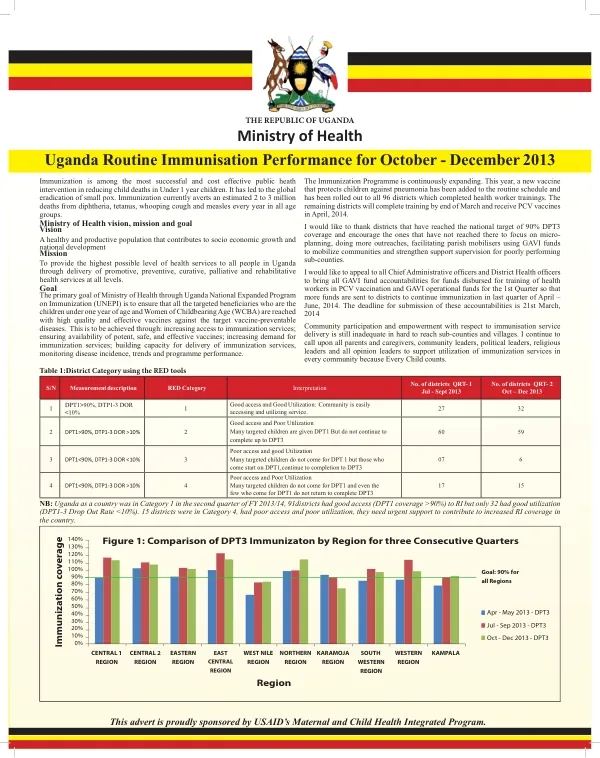
This is achieved through increasing access to immunization services, ensuring availability of potent, safe, and effective vaccines, increasing demand for immunization services, building capacity for delivery of immunization services, monitoring disease incidence, trends, and program performance. The Immunization Programme is continuously expanding, with a new vaccine that protects children against pneumonia added to the routine schedule and rolled out to all 96 districts. The remaining districts will complete training by the end of March and receive PCV vaccines in April 2014. The goal is to increase immunization coverage to at least 90% with all vaccines in every district. Analysis of district routine immunization data for October to December 2013 reveals that 27 districts had good access and good utilization, 60 districts had good access and poor utilization, 7 districts had poor access and good utilization, and 15 districts had poor access and poor utilization. The districts with poor access and poor utilization require urgent support to contribute to increased RI coverage in the country. The immunization schedule for currently available vaccines includes BCG, DPT-HepB-Hib, Polio, Measles, PCV, Rota virus vaccine, Human Papilloma Vaccine, and Tetanus Toxoid. The recommended dosage, interval, and administration site for each vaccine are specified. The analysis of problem identifies the problem, categorizes it according to the RED tool, and provides the total under one year population, immunization coverage data in the previous three months, doses of vaccine administered, and drop-out rates. The analysis is conducted for each district, including Uganda, Gomba, Lyantonde, Masaka, Rakai, Central 1 Region, Mpigi, Butambala, Wakiso, Bukomansimbi, Lwengo, Ssembabule, Central 2 Region, Mubende, Buikwe, Luwero, Buvuma, Kayunga, Kiboga, Mukono, Mityana, Nakkasongola, Kyankwanzi, Nakkaseke, Eastern Region, Mbale, Ngora, Serere, Sironko, and others. The immunization coverage for DPT1, DPT3, and Measles vaccines is analyzed for each district, and the drop-out rates are calculated. The districts are categorized according to the RED tool, with 27 districts categorized as Category 1 (good access and good utilization), 60 districts categorized as Category 2 (good access and poor utilization), 7 districts categorized as Category 3 (poor access and good utilization), and 15 districts categorized as Category 4 (poor access and poor utilization). The analysis highlights the need for urgent support to districts with poor access and poor utilization to contribute to increased RI coverage in the country. The districts with good access and good utilization are encouraged to maintain their performance, while those with good access and poor utilization are advised to focus on improving utilization. The districts with poor access and good utilization are encouraged to improve access, and those with poor access and poor utilization require urgent support to improve both access and utilization. The immunization program aims to ensure that all children complete their routine immunization schedule by their 1st birthday. The recommended immunization schedule includes BCG, DPT-HepB-Hib, Polio, Measles, PCV, Rota virus vaccine, Human Papilloma Vaccine, and Tetanus Toxoid. The recommended dosage, interval, and administration site for each vaccine are specified.