USAID DEC
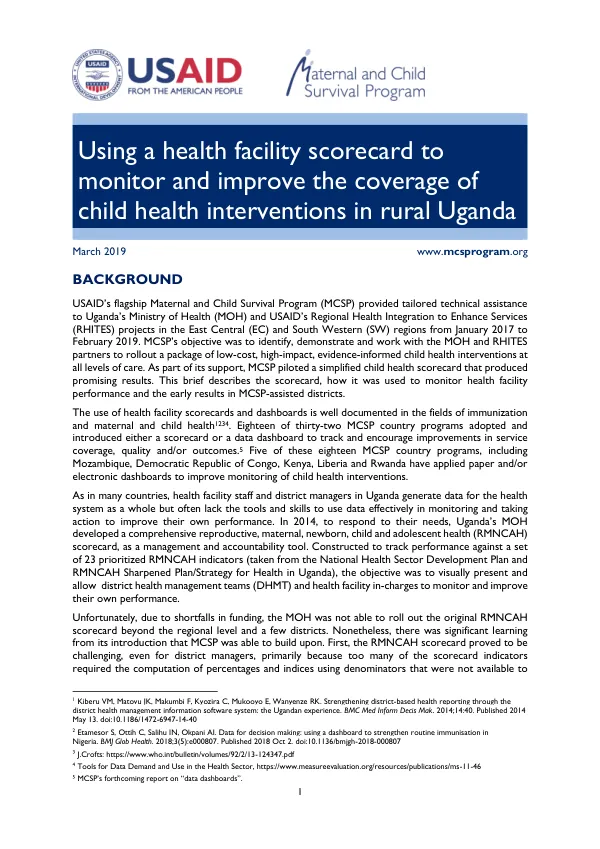
Using a health facility scorecard to monitor and improve the coverage of child health interventions in rural Uganda
Sign inMINISTRY OF HEALTH
Using a health facility scorecard to monitor and improve the coverage of child health interventions in rural Uganda
The Maternal and Child Survival Program (MCSP) provided technical assistance to Uganda's Ministry of Health (MOH) and USAID's Regional Health Integration to Enhance Services (RHITES) projects in the East Central and South Western regions from January 2017 to February 2019.
2019 · 7 pages
Sign in to readA free account is required to download.
Abstract
MCSP's objective was to identify, demonstrate, and work with the MOH and RHITES partners to rollout a package of low-cost, high-impact, evidence-informed child health interventions at all levels of care. As part of its support, MCSP piloted a simplified child health scorecard that produced promising results. The scorecard was designed to focus exclusively on child health indicators, selecting only those that could be calculated using readily available data from health facility- and community-level registers and records, and from national health management information system (HMIS) reports. The scorecard was color-coded to simplify interpretation for the various end users and highlight the levels of performance per indicator. Red indicated performance below the lowest threshold limit, or very poor performance needing urgent action; yellow indicated performance between the lower threshold and the target, or not yet satisfactory performance needing more improvement; and green indicated performance meeting or above the target, or satisfactory performance. The scorecard was field tested, reviewed, and approved by the national Maternal Child Health Cluster and the Integrated Management of Newborn and Childhood Illnesses (IMNCI) Technical Working Group before being used with the District Health Management Teams (DHMTs) and health facility in-charges to identify performance problems and develop appropriate responses. The scorecard was populated either manually or electronically, eliminating the need for a computer. The scorecard helped the DHMTs, RHITES partners, and MCSP to track critical interventions during the rollout of the essential child health package in the four MCSP-supported demonstration districts. During performance reviews, the scorecard helped with the identification of health facilities needing targeted support from their DHMTs and/or technical mentors. The scorecard also helped to identify positive outliers/leaders and some of their promising practices that other facilities were encouraged to adopt. The proportion of health facilities in the demonstration districts with functional Oral Rehydration Therapy (ORT) corners increased from 14% in October 2017 to 83% by October 2018. The scorecard facilitated the identification of health facilities that had taken the initiative to use their Primary Health Care (PHC) funds to set up ORT corners, and encouraged other facilities to do the same. The scorecard also helped to identify facilities that had implemented other child health interventions, such as the management of pneumonia and diarrhea. The use of the scorecard led to improved performance in the demonstration districts, with a significant increase in the proportion of health facilities meeting or exceeding the target for various child health indicators. The scorecard was an effective tool for monitoring and improving the coverage of child health interventions in rural Uganda, and its use was expanded to other districts and regions.