GOVERNMENT OF SENEGAL
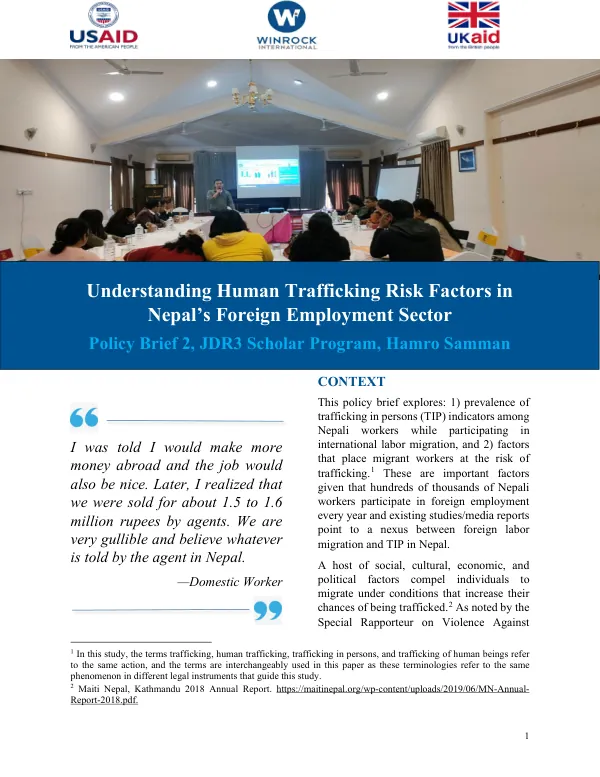
Understanding Human Trafficking Risk Factors in Nepal’s Foreign Employment Sector
Human trafficking in Nepal's foreign employment sector is a significant concern.
2023 · 35 pages
Sign in to readA free account is required to download.
Abstract
The country's migrant workers are vulnerable to exploitation, with many facing deceptive recruitment practices, coercive conditions of work, and coercion at their destinations. Deceptive recruitment involves deception about the work, wages, contract content, travel, and recruitment conditions. Coercive recruitment includes withholding of money and debt bondage, confiscation of documents, and excessive work hours. The push factors of migration, such as poverty and unemployment, contribute to human trafficking for labor exploitation. Unregulated labor intermediaries, vulnerability associated with employment sectors, rampant fraud, and lack of choice in the labor recruitment market also exacerbate the issue. Weak implementation of existing policies in destinations and counterproductive protectionist policies further contribute to the problem. The use of tourist visas for labor recruitment is another issue, as it allows for lax implementation of existing policies. The government of Nepal has implemented various laws and policies to combat human trafficking, including the Human Trafficking and Transportation (Control) Act, 2007, and the Foreign Employment Act, 2007. However, gaps in the domestic legal framework remain, and the laws are not effectively enforced. Research conducted by the John D. Rockefeller 3rd Scholars Program, in partnership with the Hamro Samman Project, and funded by USAID and UK Aid, has identified key factors contributing to human trafficking for labor exploitation. The study involved a desk review, in-depth interviews, focus group discussions, and key informant interviews. The research team collected data from various sources, including government agencies, non-governmental organizations, and migrant workers. The study found that migrant workers from Nepal are often subjected to exploitative conditions of work, including excessive work hours, non-payment of wages, and poor working conditions. Coercion at destinations, including violence, control over passports, and debt bondage, is also a significant concern. The research highlights the need for effective implementation of existing policies, strengthening of the legal framework, and protection of migrant workers' rights. The study's findings have significant implications for policy and practice. The government of Nepal, in collaboration with international organizations and civil society, must take concrete steps to address the root causes of human trafficking and protect the rights of migrant workers. This includes strengthening the legal framework, improving labor regulations, and enhancing the capacity of law enforcement agencies to investigate and prosecute human trafficking cases.